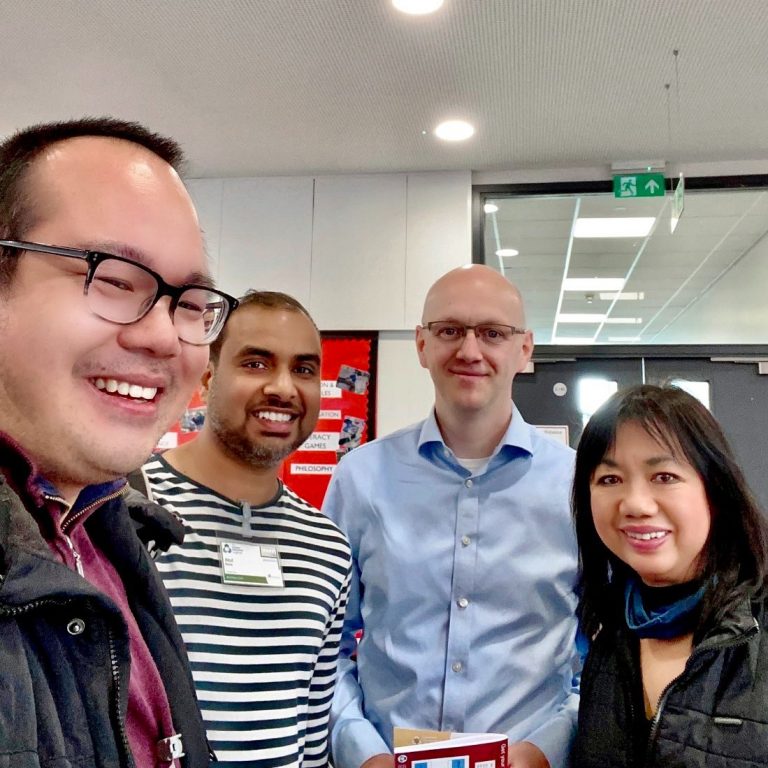
MathsConf41 Liverpool – With a Little Help From My Maths Friends
imagine how good maths education would be if mathematics teachers knew each other as good friends.
Going to a Complete Mathematics conference always reminds me of this line by Mark McCourt when he used to open the day. Teaching can be lonely and challenging, especially in a culture where admitting to loving maths can still make many people look at you rather strangely. But put hundreds of maths teachers under one roof, talking, sharing ideas, arguing about methods and helping each other, and something amazing happens.
So perhaps it was fitting that MathsConf41 brought us to Liverpool, home of the Fab Four. Because for all the workshops, resources and clever teaching ideas, the thing that keeps striking me about MathsConf is something The Beatles understood rather well:
We get by with a little help from our friends.

It all started with the Friday night pre-conference meetup at the Premier Inn where there was plenty of mingling and maths chatter. That informal CPD has always been one of the most valuable parts of MathsConf.
On to the Saturday itself, we all converged to Maghull High School and were given a tote bag and our badge. There was lots to see and many stands to browse, from maths education companies, resource makers and exam boards. The introductory talks started at 09:30 at a main hall that is normally used to the arts and music, an inspirational and creative space with a little pyschadelic coloured acoustic guitar in the corner. We were welcomed by Complete Mathematics, the main sponsors AQA and the school staff hosting the conference.

One of the things I really like about MathsConf is that it breaks up the London-centric nature of education events, education policy and CPD. By moving all over the country it gives different schools the chance to host the conference, and becomes local for that school and region.
To the workshops themselves.
Workshop 1 : Building Exam Resilience: Turning Blank Pages into GCSE Points by Suzanne Preston
Suzanne’s workshop focused on struggling GCSE pupils who can look at an unfamiliar question and simply give up. Her wonderfully pragmatic starting point was: forget solving the whole thing and just find a way to get that first mark. So what does that mean in practice?
Some of the many examples she demonstrated were:
- Fill in every angle you can by default: angles on a straight line, or inside a triangle.
- If there is a scatter graph, draw a line of best fit.
- For a fraction operation, find a common denominator before doing anything.
- For a tiling or painting-a-wall-to-find-if-there-is-enough-paint question, find an area straightaway, and look for the word ‘cover’. The area calculation will most likely be a rectangle or triangle.
- For a wordy ratio question, rewrite the ratio in symbolic form.
…and so on. The idea is that when a pupil looks at the paper and internally screams Help!, the first job is simply to give them somewhere mathematical to begin.
Underneath this was a bigger idea about reducing cognitive load. Suzanne advocated a fairly ruthless optimisation process: concentrate on high-frequency material, use familiar representations (bar models and ratio tables mostly) and give struggling pupils reliable ways into questions. Eventually, the hope is that they stop seeing every GCSE paper as something completely new and instead recognise “the same topics dressed in different clothes.” That phrase really stayed with me.
Interestingly, this initially felt almost like the inverse of my own thoughts on method selection, where I deliberately mix topics so pupils have to decide which mathematics to use. But perhaps these are simply different stages of the same journey. Suzanne is reducing decisions for pupils who are overwhelmed; I am deliberately introducing uncertainty once the mathematical toolbox is secure enough. By then these pupils are further along the journey of mathematical maturation.

One of my favourite takeaways was how Suzanne applied this thinking to the quadratic table shown above, for . Two values were already given: when , , and when , . Rather than asking a struggling pupil to calculate every missing value by substitution, she went hunting for the easiest marks.
- The first is almost free: when , both and disappear, so the constant term tells us immediately that .
- Then look at the pattern of a quadratic graph. Here the coefficient of is positive, so we expect the familiar “smiley face”, with the -values mirrored either side of its line of symmetry. Since gives , the matching point at must also give .
Two blanks filled without having to grind through the whole table, scoring 1 easy mark. Of course, as mathematicians we want pupils eventually to understand why all of this works, but I loved the idea of beginning with what they can notice. Mathematics is full of patterns, and I can see myself letting pupils spot and exploit the pattern first before asking the much more interesting question: why?
Workshop 2 : Revision Reimagined: Core Concepts, Connected Maths, Better Outcomes by Liza Johns
Liza’s workshop was centred around one deceptively simple question:
What do students need to know about triangles?
We had to think about it ourselves first and then discuss it with the person next to us. I started with the obvious stuff:
- different types of triangles – isosceles, equilateral, scalene, right
- angle sums
- area and perimeter
- Pythagoras
- trigonometry
- bearings
- transformations
- even cutting polygons into triangles to understand their interior angle sums
The humble triangle had suddenly exploded into a huge chunk of the GCSE curriculum. I had never sat on a triangle centric mathematics viewpoint before, so this was fun! James Acaster once said, “Every triangle is a love triangle when you love triangles.” After this workshop, I am prepared to accept this as a theorem.

Instead of revising maths as a long checklist of isolated topics, she was encouraging us to organise revision around rich core ideas that naturally connect to many others. Her triangle connection map made this wonderfully visible, branching into angles, area, trigonometry, similarity, coordinates, transformations, vectors, proof and much more. She then gave us sets of triangle questions that deliberately pulled several of these ideas together. The difficult bit of GCSE maths is often not knowing an individual method; it is recognising which bits of mathematics are hiding inside the question.
Liza also mentioned that she is a big fan of Nathan Day’s Interwoven Maths, which immediately made sense to me. I had seen Nathan speak at MathsConf28 and wrote about his workshop afterwards. His whole approach is about deliberately connecting different areas of mathematics into carefully designed tasks rather than allowing topics to sit in isolation. At that workshop he even took a simple right-angled triangle and progressively interwove it with surds, fractions, standard form, algebra, ratio and other ideas.
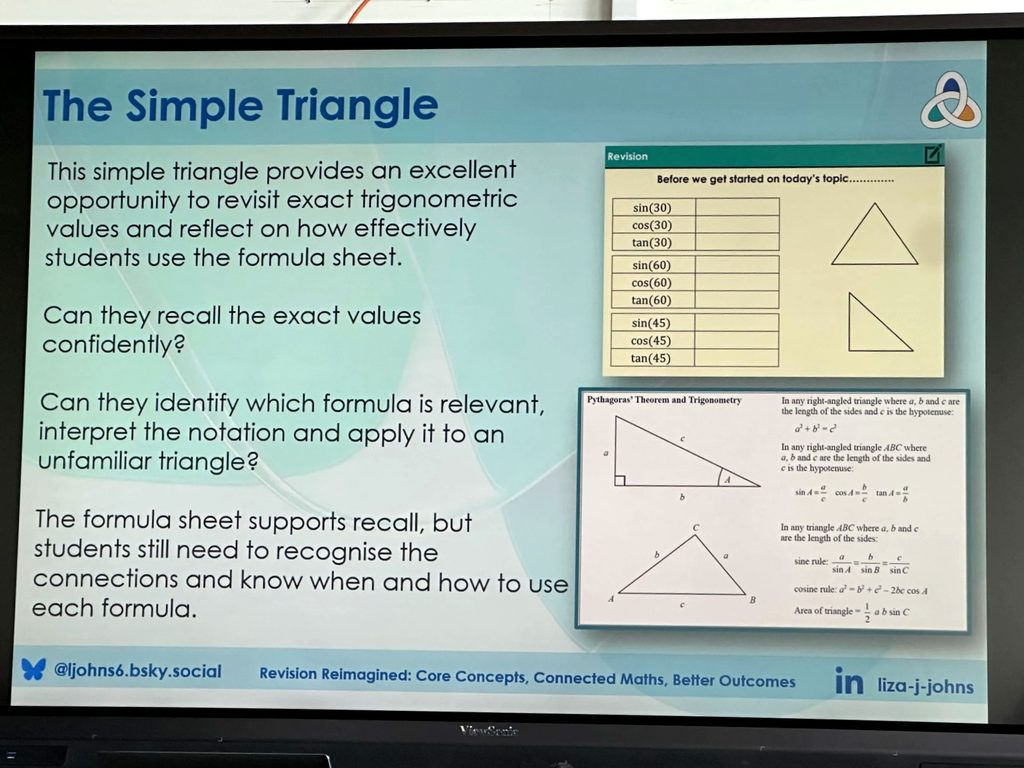
There was a nice AI angle too. Liza had asked AI essentially the same question we had been given and later used it to help produce that wonderful sketch-style connection map. I thought this was a really sensible use of AI: not replacing the mathematical thinking, but helping organise and visualise it. I use AI too (even in sharpening and structuring my thoughts on this very blog post).
A nice final note was that Liza had travelled several hours from Cornwall to be at MathsConf41, the furthest travelling delegate, and very much in the spirit of this travelling maths community. As Director of Mathematics for Cornwall Education Learning Trust, she works across schools on curriculum and maths improvement, and fittingly the journey will soon reverse. It will be our turn to go down the Long and Winding Road to MathsConf43 at Penrice Academy in Cornwall.
Liza’s enthusiasm, energy and delivery of the workshop was infectious and many of us were already looking up train fares to Cornwall.
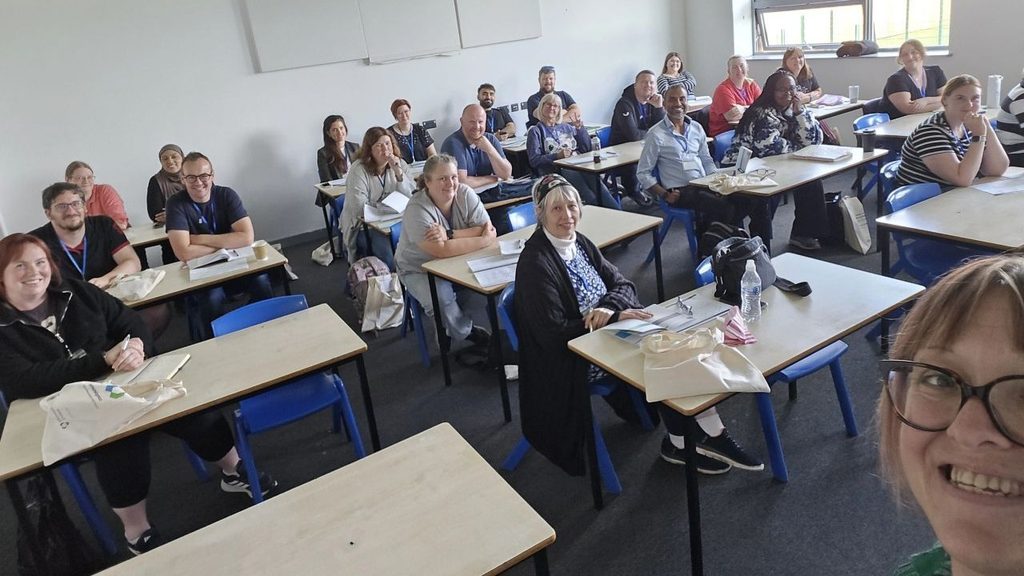
Workshop 3 : Time to revisit…Probability by Peter Mattock
Pete’s workshop began with a deceptively simple statement:
Probability is a measure of the chance of something happening in the future.
and the natural follow on question:
What does it mean to measure something?
That immediately got me thinking. I have spent a ridiculous amount of time thinking about measurement over the years. I even read Paul Lockhart’s entire book Measurement which I very highly recommend. For me, measurement is fundamentally about comparison. Nothing is really measured in some absolute sense. We choose a unit, compare one thing with another, and eventually standardise that unit so everybody agrees what we mean. A desk might be three pen-lengths long; later we decide it is rather more useful if everyone uses metres.
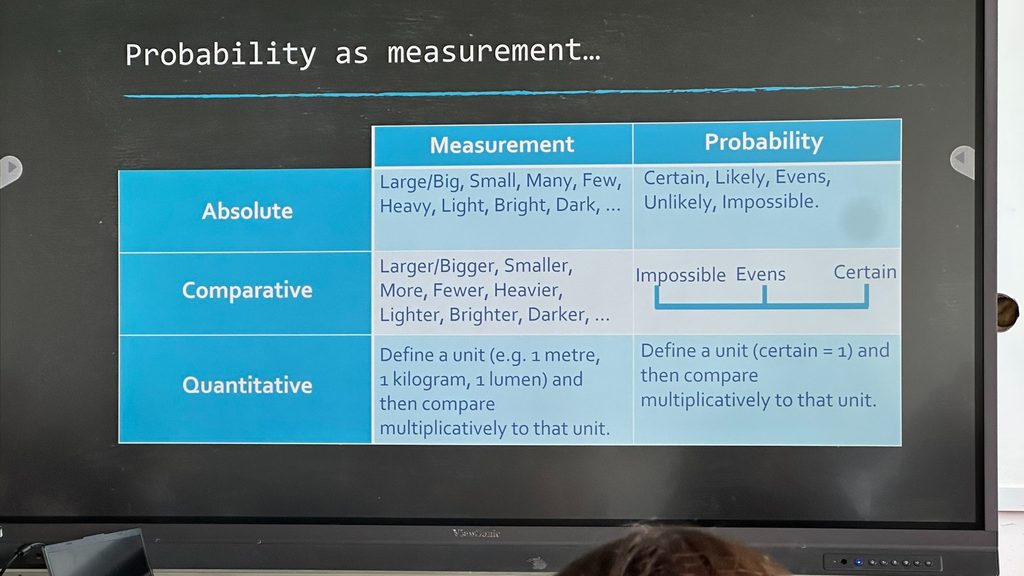
I had never thought of probability as a measurement before. It had always felt like one of the more abstract areas of school mathematics, whereas measuring length, area or mass feels much more tangible. But the same structure is there. With probability we effectively take the whole space of possibilities and give it a measure of , i.e certainty, and everything else is measured relative to that. A probability of is therefore not just a mysterious decimal attached to an event; it is a measure of how much of that total certainty we assign to it. Once I saw probability through that lens, it suddenly felt much more concrete.
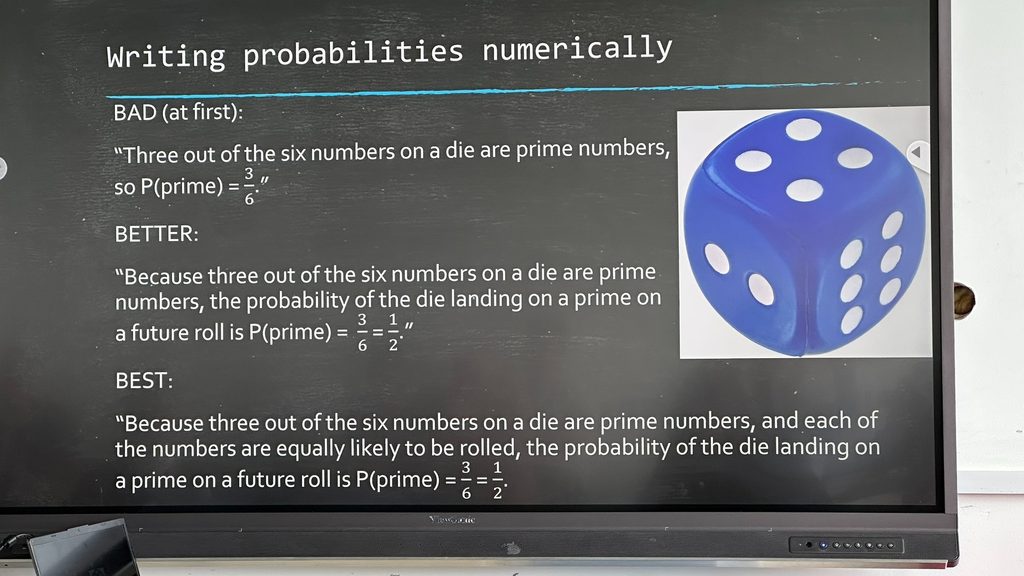
Pete also emphasised the words “in the future”, which led to another important distinction. School probability can give a rather distorted impression of the subject because we spend so much time with fair dice, cards and coloured counters where probabilities can be calculated theoretically. Much of real life is nothing like that. We cannot calculate tomorrow’s weather, future economic growth, the movement of a share price, or even next year’s GCSE grade boundaries from first principles. We observe what has happened before, build a model, estimate probabilities and then project them forwards. It is an inevitably uncertain art, but decisions still have to be made before the future arrives. Tomorrow Never Knows.
The rest of Pete’s workshop went into how we represent and reason about probability, including connecting sample spaces, tree diagrams, Venn diagrams and two-way tables (connecting two-way tables with Venn Diagrams is one of those blindingly obvious and revealing ideas once you have seen it, but I had not connected the two together).

I have known Pete ever since I joined the MathsConf community and am a big fan of his work, particularly his deep knowledge in the use of manipulatives and representations. His time to revisit series were a hit before Covid and he has covered many other topics. I have done a few #MathsChatLive episodes with him and highly recommend checking out his resources, books (I have both Visible Maths and Conceptual Maths) and YouTube channel.
Workshop 4 : Mathematical Surprises by Zoe Griffiths
I rushed to this workshop being about a minute late and managed to grab the last chair in the room. I had never heard of Zoe Griffiths before and had chosen the session simply from the description, partly looking for some mathematical inspiration for myself and, hopefully, some ideas I could take back to my students. There was a good reason the room was packed.
Zoe was a fantastic communicator. She has clearly spent a lot of time giving mathematical talks, she even does maths stand-up comedy and knew exactly how to use suspense, pauses and audience participation to keep a room full of maths teachers completely hooked.
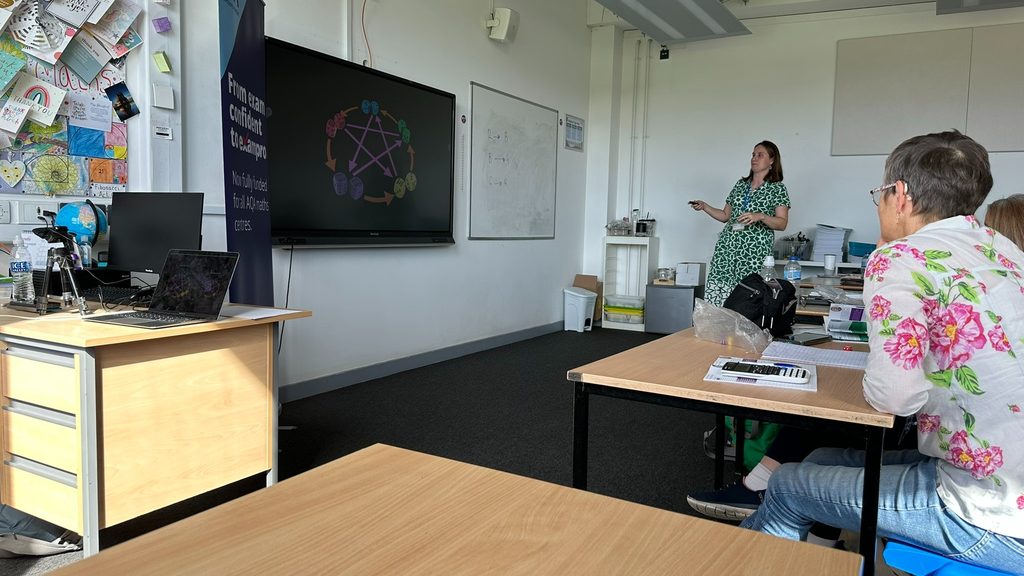
I also liked the way she framed the workshop. She wasn’t going to tell us that we should teach anything in a particular way. Instead, she was going to show us a collection of mathematical surprises and leave us to decide what mathematics we might draw out of them and how we might use them with our own pupils.
One of her opening tricks was beautifully simple. Take any three-digit number, say and repeat the digits in order to make a six-digit number: 738,738
Now divide by 7. What does everyone get?
A whole number.
Divide by 11. What does everyone get now?
Still a whole number!
Then divide by 13. What does everyone get now? Not only does it divide exactly again, but you arrive back at the number you started with: 738. The suspense had been building and there were little gasps around the room at this revelation.
Zoe didn’t immediately tell us why it worked. Instead she encouraged us to attack it ourselves, and within seconds the room was full of maths teachers scribbling away. I spotted that with the number 1001 being heard across many tables. I had scribbled 7 x 11 x 13 = 1001, and just as I was about to use algebraic proof, Zoe revealed the reason using a great example:
738,738 = 738,000 + 738
= 738(1000 + 1)
= 738 x 1001
What had looked like mathematical magic suddenly made perfect sense. I loved that structure: first create the surprise, then give people enough space to desperately want to explain it. I can see myself trying this trick out in different bases to see what wonderful insights and structures it reveals.
Another trick involved calculators and a missing secret digit. After a sequence of operations, Zoe could work out the digit somebody had deliberately withheld. The trick ultimately came down to divisibility by 9: the resulting number was a multiple of 9, so its digits had to sum to a multiple of 9 and the missing digit could be reconstructed from the others. By this point, being in Liverpool, I could almost hear “number nine… number nine…” playing in my head.
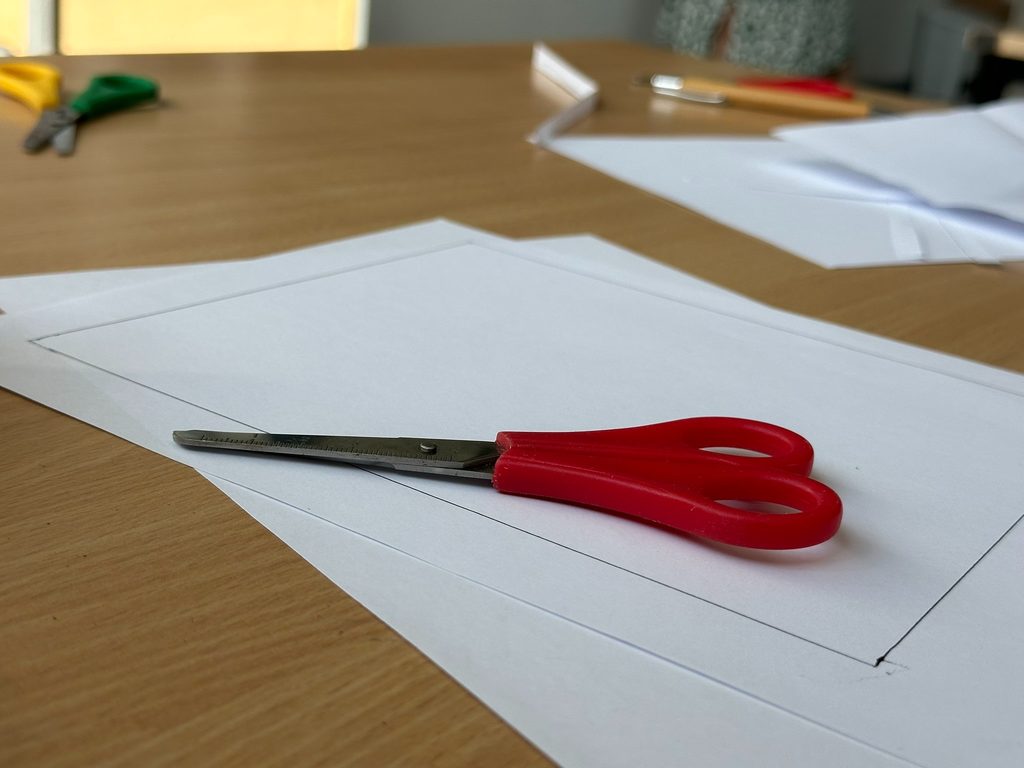
We also played with some wonderfully strange Grimes dice and probability before moving on to paper, folding and scissors. Zoe asked us to draw a rectangle somewhere inside a sheet of paper and find the least number of straight cuts needed to cut it out. Then came the much more interesting question: what if we are allowed to fold the paper first?
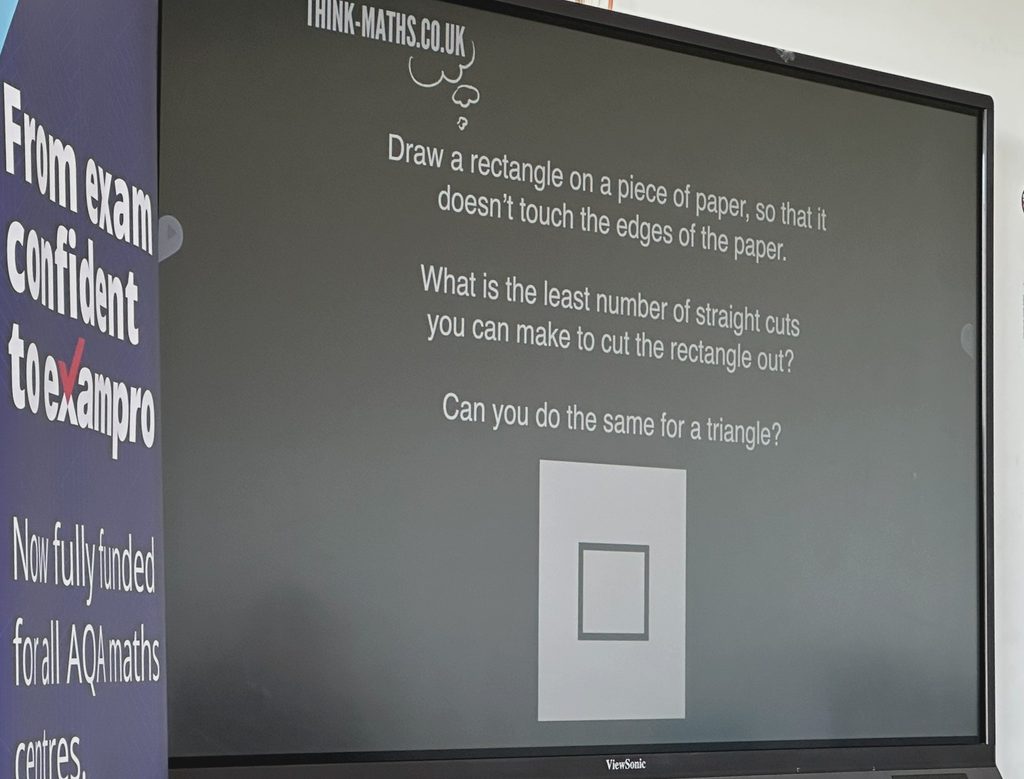
This led into the extraordinary fold-and-cut problem. With sufficiently clever folding, even complicated arrangements of straight-line cuts can be produced with a single straight cut. It turns out that All You Need Is One Cut.
What I liked most about Zoe’s workshop was that none of these surprises were really the endpoint. The trick created that wonderful ‘How on earth did that happen?’ feeling, but then that feeling became the motivation for doing the mathematics. She was particularly good at creating the moment of surprise and then knowing when to stop talking and let us investigate.
There is something quite powerful in that for teaching. We spend a great deal of time thinking about how to explain mathematics clearly. Perhaps sometimes the better first question is: how can I make pupils curious enough that they really want the explanation?
Zoe left us with plenty of resources just for those who attended MathsConf on this link.
Workshop 5 : Get more from every intervention: a framework for what good one-to-one maths support looks like by Paul Coffey & Natalie Thompson
My final workshop was the one closest to my day job. Paul Coffey and Natalie Thompson were looking at what good one-to-one maths support actually involves, particularly what a tutor does when a pupil gets stuck.
One of their slides summed it up beautifully:
Good tutoring is thousands of tiny, well-judged calls.
I completely agree. After many thousands of hours of one-to-one tutoring, that is very close to how I think about the job. At the heart of those calls are the questions we ask, how we interpret the answers and what we decide to do next. An expert tutor knows which questions to ask and how.

When a pupil blanks out, Do I ask another question? give a hint? Draw a representation? Remind them of something they already know? Go back and investigate whether the real problem lies several layers earlier? Or do I simply shut up and let them wrestle with it for another thirty seconds?
One of the most important judgements is distinguishing productive struggle from unproductive struggle. Paul and Natalie broke the process down into four stages: Notice, Read, Give, Fade. Notice what the pupil is doing, read what that behaviour might tell you, give appropriate support and then gradually fade that support away. Help too quickly and you can steal the thinking from the pupil; wait too long and productive struggle can simply turn into frustration. This is what makes good one-to-one tutoring much more than simply explaining mathematics to one pupil instead of thirty.
The particularly interesting part of the session was what happens when some of this is handed over to AI. Third Space Learning have developed Skye, an AI maths tutor designed to respond to pupils as they work. Rather than pretending to know what is happening inside a pupil’s head, it uses things it can actually observe: answers, timing, hints used, silences, repeated errors and whether the pupil recovers after support. As one slide put it:
Name what they do, not what they feel.
So, wisely, no I’ve Got a Feeling from the AI. Let’s leave that to us humans.
I liked that distinction. A human tutor has access to much more than the written mathematical trace: tone of voice, hesitation, facial expression, confidence, the history of previous lessons and all sorts of subtle signals. An AI tutor has to be much more explicit about the evidence it uses to decide whether a pupil is productively struggling, stuck in a loop, disengaging or recovering after support.
I was also interested in the 30-minute session length, because this is something I have independently arrived at after experimenting over the years with 10, 20, 30, 40-minute and longer sessions. Thirty minutes seems to be a useful sweet spot: long enough for substantial mathematical thinking, while still being manageable cognitively and organisationally.
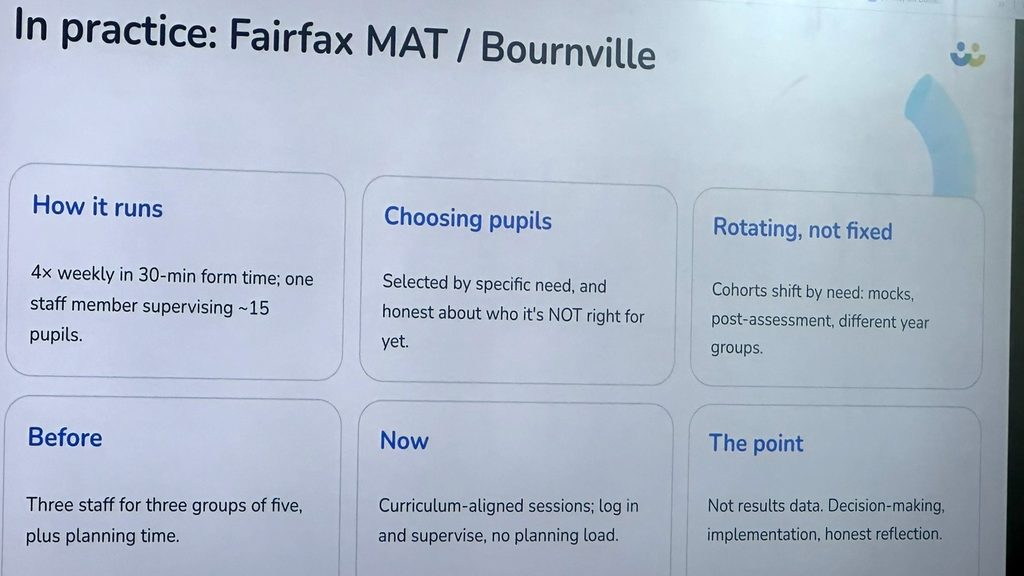
What I appreciated most was that this was not presented as “AI solves tutoring.” We heard from a school that had actually used the system and had been selective about which pupils it was appropriate for. Some pupils found talking to an AI voice too impersonal and chose not to continue, while pupils who were much further behind still needed specialist intervention from a teacher. I was glad those limitations were discussed openly.
That last point is particularly important to me. The tutoring being described felt responsive, but it was not quite the deepest form of mastery tutoring I sometimes use. If a pupil cannot do the question in front of us, I may keep travelling backwards through the mathematics until I find the precise place, or places, where their understanding has fractured.
So I left my final workshop with something I already believed but never quite had the words for: much of the expertise in tutoring lies in those thousands of tiny decisions when to intervene, when to wait, how far back to go, what representation to introduce and when to withdraw the scaffold again.
Final thoughts – ResearchEd clash, community and where maths chat goes next
Beyond the workshops themselves, there was plenty of complimentary tea, coffee and biscuits throughout the day as well as a hearty lunch. The breaks had their usual MathsConf buzz: delegates comparing notes, articulating their ideas, catching up with old friends and meeting new people. At lunchtime there was a Maths Mingle, with Bridge on offer for anyone who fancied it, although most people simply chatted or escaped outside for a solo break. Rob’s Tuck Shop and the charity raffle were also raising money for Macmillan Cancer Support, the perfect excuse for a mid-conference sugar hit, even if Rob himself was not there this time.
And this being a gathering of teachers, it is never entirely surprising to spot somebody spending their lunch finishing a lesson plan or marking a pile of mock papers!
MathsConf41 also happened to clash with researchED in London. ResearchED was within walking distance of my home in east London, so attending would have involved virtually no travel or accommodation costs. There were some maths sessions there too, including one from Mark McCourt, founder and former CEO of Complete Mathematics. Mark is no longer involved with MathsConf, and although I have heard him speak many times over the years, particularly during the old MathsChatLive days, I would still have liked to hear him again.
But I knew Liverpool was where I wanted to be. The clash inevitably meant that some maths teachers who might otherwise have attended or spoken at MathsConf were elsewhere that day. It also made me think again about something I wrote after my previous conference: what has happened to the wider online maths community?
For all its faults, the old maths Twitter was once an extraordinary engine for informal CPD. Teachers asked questions publicly. Someone might post that they were struggling to teach fractions, simultaneous equations or ratio, and within minutes other teachers would be suggesting representations, sharing tasks, linking blogs and disagreeing enthusiastically about the best approach. One person’s question generated learning for hundreds of other people who happened to be watching.
Blogs, podcasts, books, conference reflections and late-night arguments all fed into that ecosystem. The online community drove events like MathsConf, while the conferences generated conversations that flowed straight back online. It was a wonderfully productive cycle. Some of that community has moved to Bluesky and LinkedIn, but I suspect some of it has simply disappeared.
AI entering the picture has no doubt changed things too. When teachers or tutors have a professional question today, I suspect many of us no longer automatically throw it out to a public network. We ask an AI instead. I certainly do. It is fast, private and extraordinarily useful. But something is lost if a question that once produced a public conversation between twenty teachers now happens privately between one teacher and a machine.
That does not mean AI needs to replace professional community. In fact, perhaps it could eventually do the opposite, helping us think more deeply before we bring ideas back to other humans, or making it easier to share, challenge and develop our thinking. But it does feel as though we are currently somewhere between versions of the online maths community. The old social-media model is fading, and I am not yet sure what replaces it.
After nearly a decade of attending these conferences, I sometimes wonder whether I must surely have heard most of the big ideas about teaching mathematics by now. And then I go to another one and come away thinking about helping struggling pupils grab their first mark, triangle centric worldviews, probability as measurement, using mathematical surprise to provoke curiosity, and the thousands of tiny decisions that make up good tutoring.
The workshops matter, but so do the conversations, friendships and the chance to spend a day surrounded by people who are still curious about how mathematics is learned. That mixture of ideas and community is what keeps drawing me back. And I cannot wait to Get Back to the next MathsConf.