MathsConf42 Barnsley – A Farewell to Complete Mathematics
MathsConf42 was the conference that nearly didn’t happen at all. Workshop leaders had been told that Complete Mathematics was closing and the conference was cancelled. I had already booked my hotel and decided to go anyway. A few regulars had the same idea as we could still spend a Saturday together talking about maths teaching.
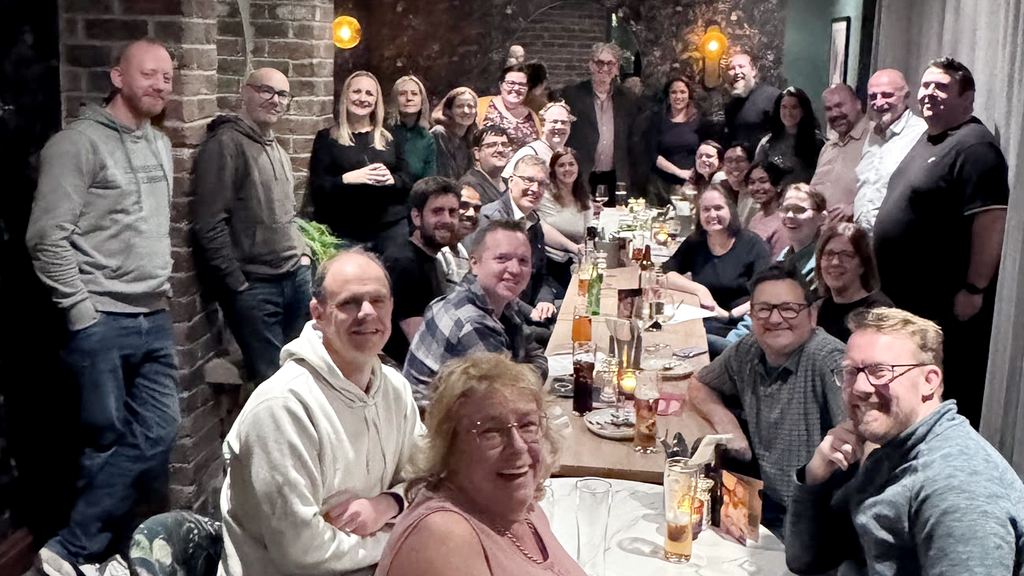
It was too late for the conference to be cancelled and a willing group of MathsConf regulars, the host school and main sponsor AQA rallied together to save the event. Thanks to their efforts, we gathered at Trinity Academy St Edward’s in Barnsley after all. The conversations began at Friday’s social at the Premier Inn beforehand, where I got to catch up with old friends and make plenty of new ones.
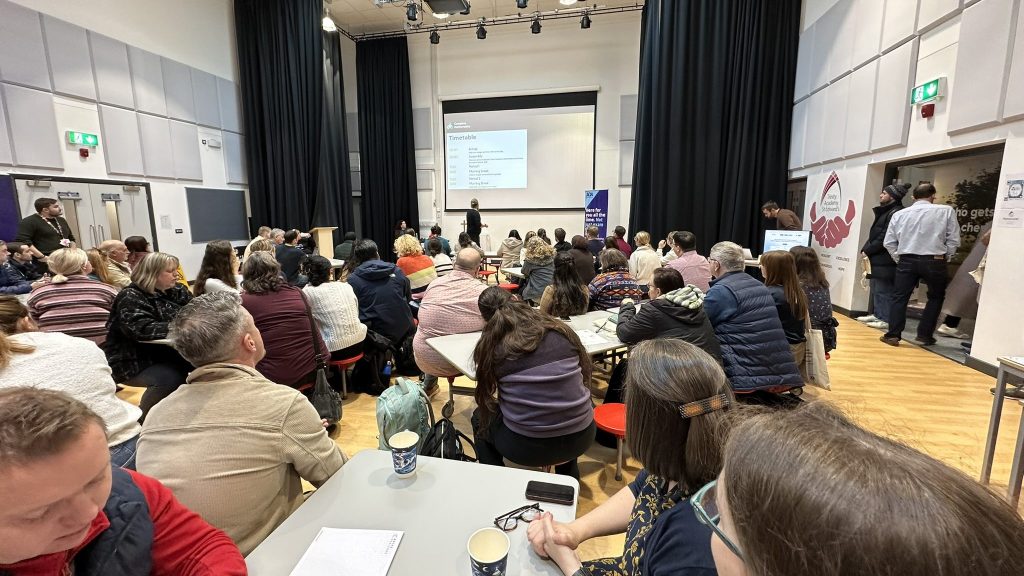
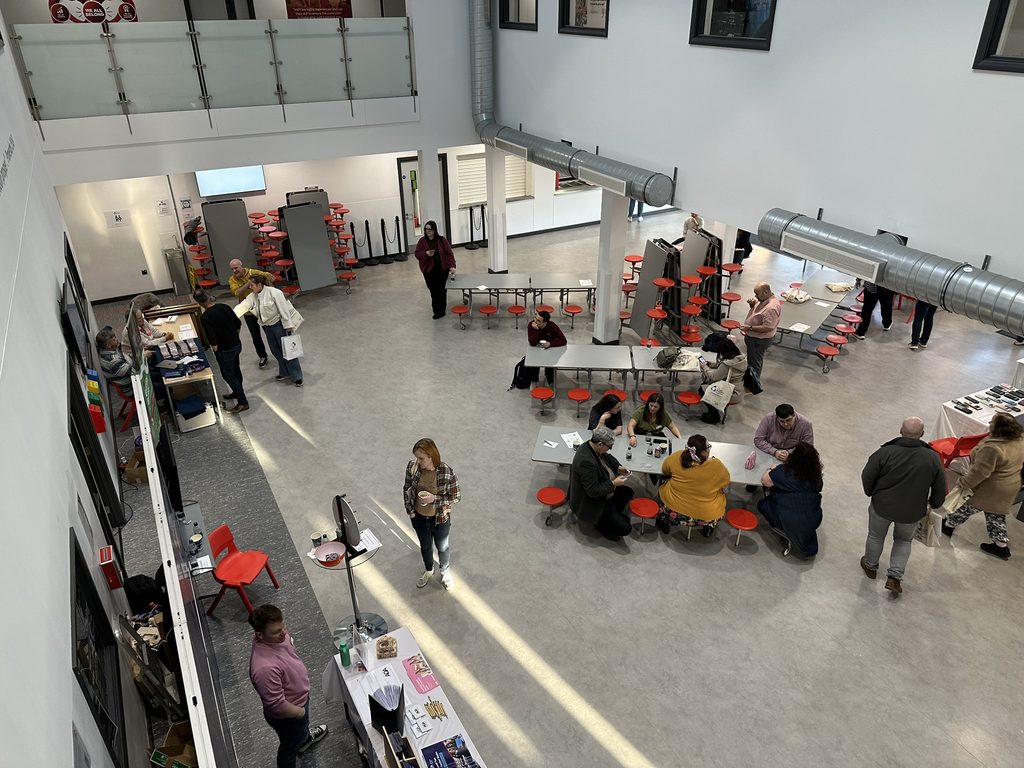
On a chilly and clear Saturday morning I walked to the host school from the Premier Inn with Jonny from MathsBot. On arrival I recognised only two members of the Complete Mathematics team, where previously there might have been a dozen or more. School staff, MathsConf regulars and other volunteers were helping everyone. The classic tote bags were still there, while the printed programme had moved online. The exhibitors hall was busy as always and there was a real buzz. Given how close we had come to having no conference, it was remarkable to see the day taking shape.
There was a welcome by Pete Mattock on behalf of Complete Mathematics as well as by main sponsors AQA. Our host, Will Wilson, then gave a welcome that stayed with me. He spoke about his maths teacher, Miss Corkran, whose enthusiasm and teaching had inspired his love of the subject. He said enthusiam for maths teaching was infectious. She had recommended a book by Rob Eastaway and a few years later, Will met Rob and had it signed. He was firmly in favour of meeting your maths heroes.
His story touched on something central to why I keep coming back. A teacher’s enthusiasm, encouragement and belief in a pupil can have consequences that last for years. That enthusiasm passes between teachers too, through the ideas we share and the curiosity we awaken in one another. There was plenty of that to come in the day ahead.
Workshop 1 : Bringing Joy to Area and Perimeter by Heidi Morris
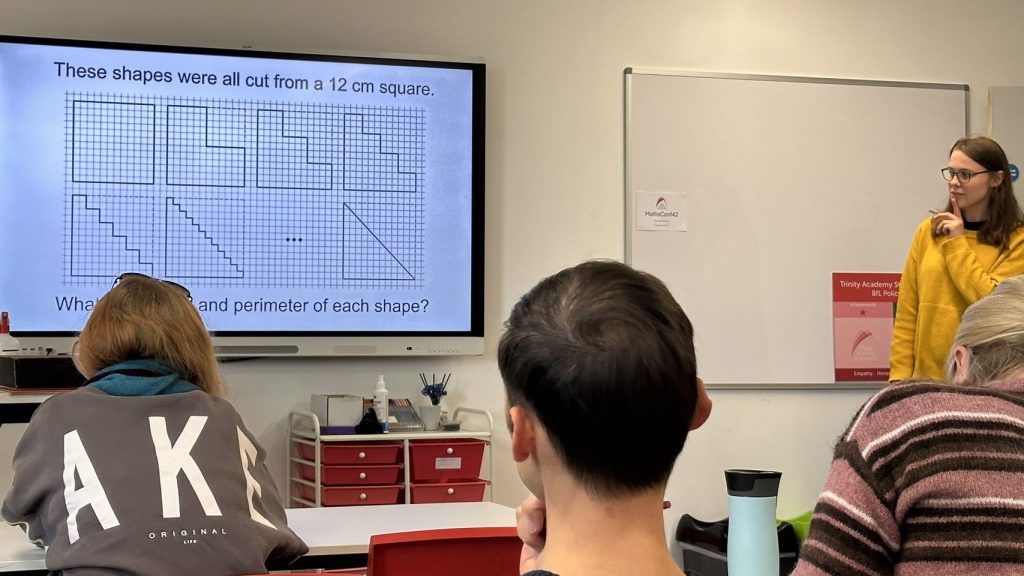
Heidi began by reflecting on how much area and perimeter pupils encounter at Key Stage 2, yet how patchy their understanding can be arriving at secondary school. In her experience, this often means teaching the topic again almost from scratch. Simple prompts, such as asking pupils to draw a rectangle with a given area or perimeter, can reveal what they understand about the two measures.
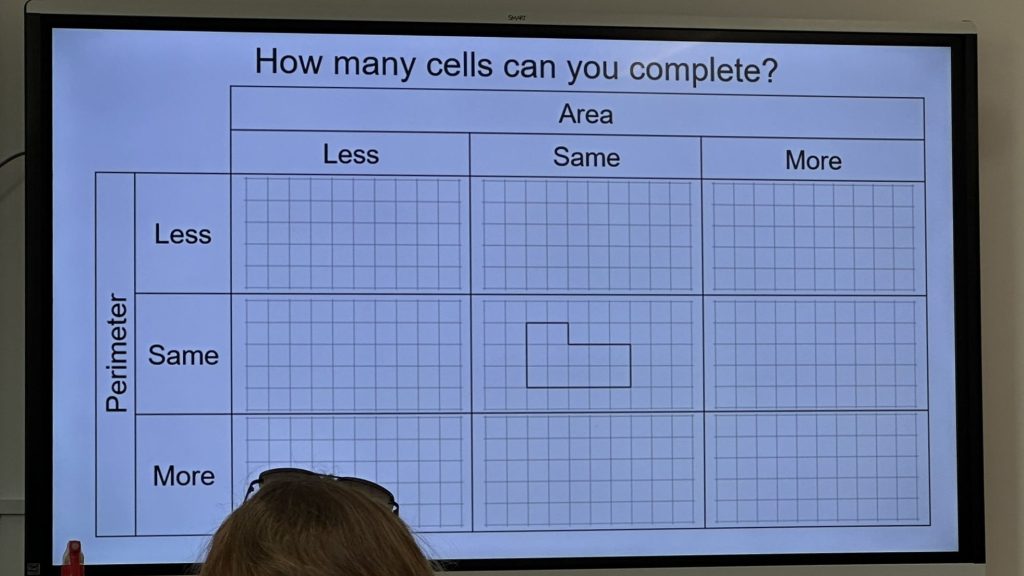
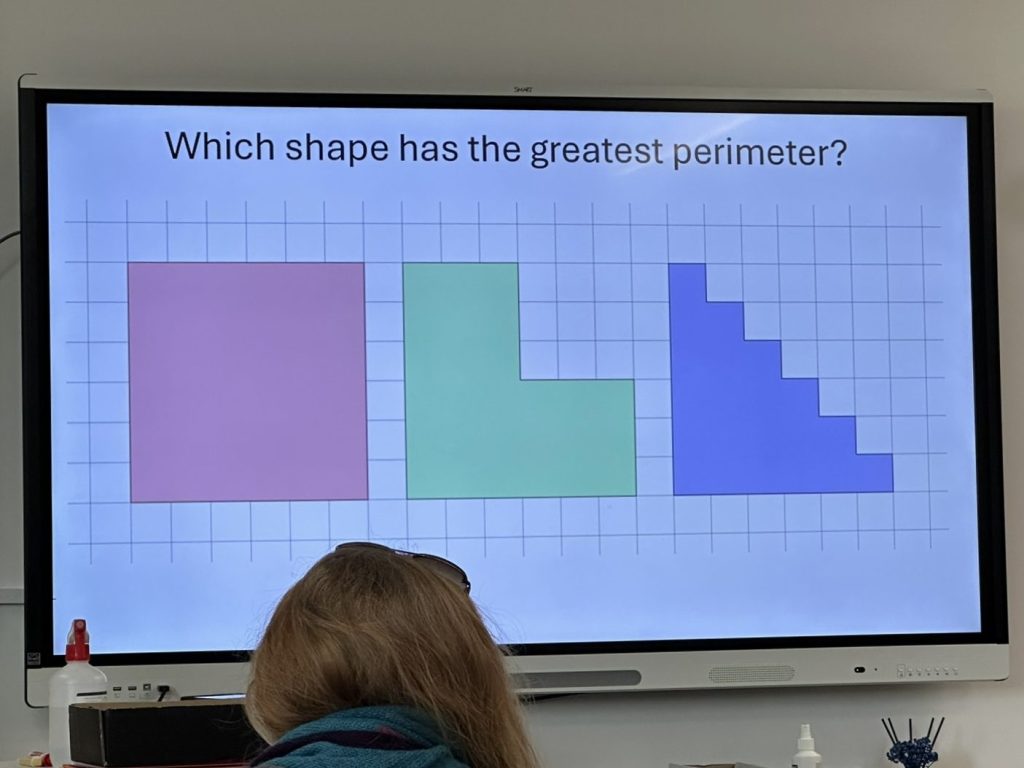
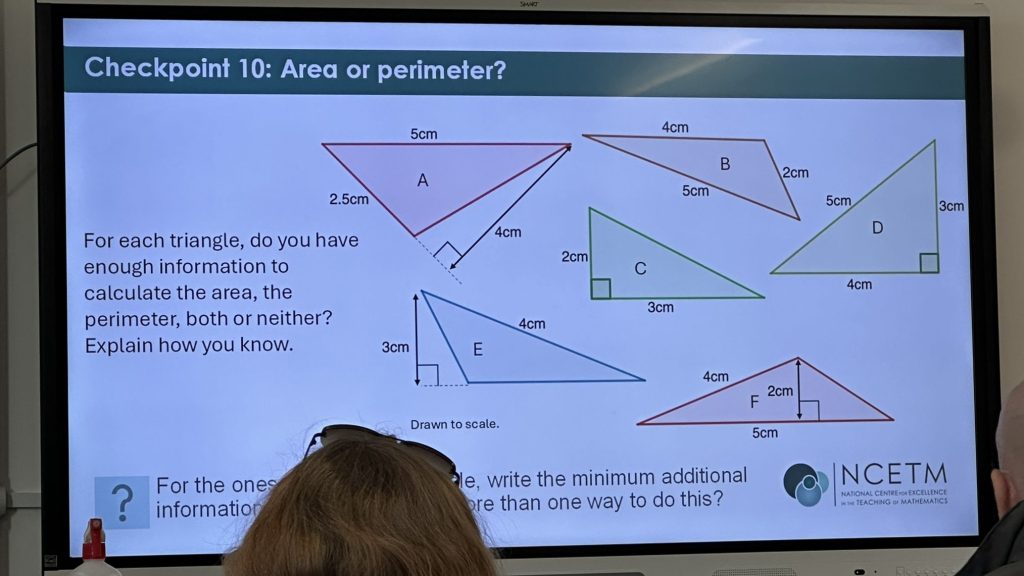
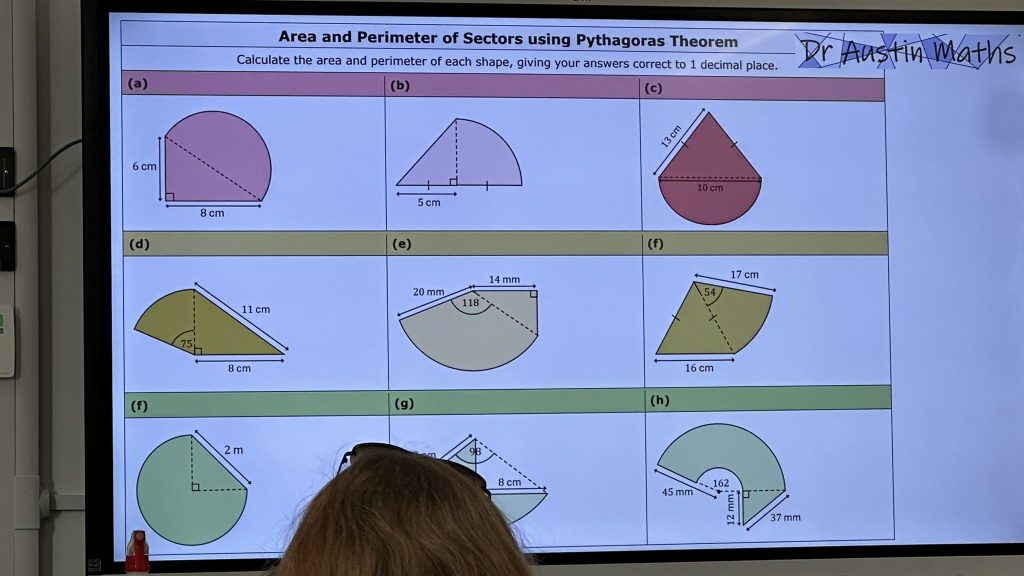
She then went on to share some lovely tasks, a selection of which appear in the photographs below. Several explored how changing a shape affects its area and perimeter. One MathsBot task asked pupils to construct shapes with different combinations of smaller, equal or larger areas and perimeters relative to a given shape. There is plenty to explore before introducing another formula.
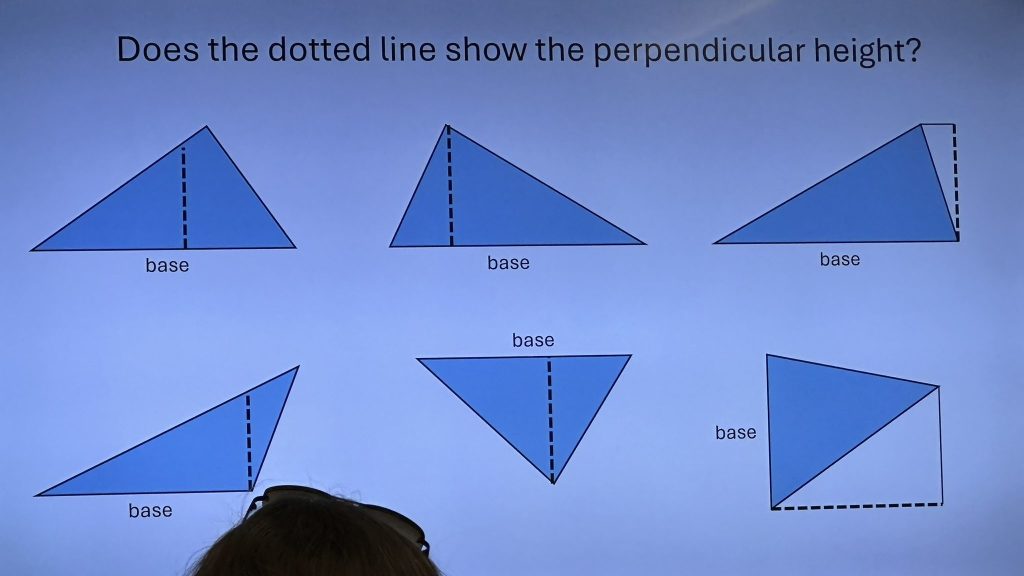
The attention to perpendicular height in particular grabbed my attention. Pupils first need to understand what perpendicular means, then recognise how a height relates to the chosen base. A series of triangles asked whether a dotted line represented the perpendicular height, varying the orientation and placing lines both inside and outside the shapes. Another task asked pupils to identify more than one base–height pair for the same triangle. Knowing the area formula is only useful if you can identify the measurements it needs.
An NCETM task took this further, asking whether the measurements supplied were sufficient to calculate each triangle’s area, perimeter, both or neither. Pupils had to explain their reasoning before calculating and, where information was missing, identify what else they needed. I liked how this shifted the attention from carrying out a calculation to deciding whether it was possible in the first place.
The workshop also prompted me to reconsider the teaching sequence to: rectangle, then parallelogram, then triangle. Rearranging a parallelogram into a rectangle can bring clarity to the relationship between base and perpendicular height. A triangle can then be connected to a parallelogram with twice its area, giving meaning to the additional step of halving.
Heidi also extended the tasks to circular shapes, including finding the perimeters of sectors and shapes made from circular arcs. These required pupils to identify exactly which curved and straight edges formed the boundary before calculating its length.
Area and perimeter are conceptually rich topics. Pete Mattock’s Visible Maths, Paul Lockhart’s Measurement and the Complete Mathematics CPD days have all deepened my understanding of what measurement involves. What are we measuring? What unit are we using? Why does the calculation give us that measure?
Heidi has kindly made the conference slides available here.
Workshop 2 : Cover to Cover: The Benefits of Booklet Based Lessons by Adam Mercer
Adam’s session explored how booklets can support classroom teaching, drawing on several years of using them himself. I liked his phrase “planning learning episodes”, which shows how a sequence of learning might not fit neatly into a single lesson. Bringing examples, questions and space for working together makes it easier to follow pupils’ progress and revisit earlier work. “Look back at example four” is a precise instruction when everyone knows where example four lives.
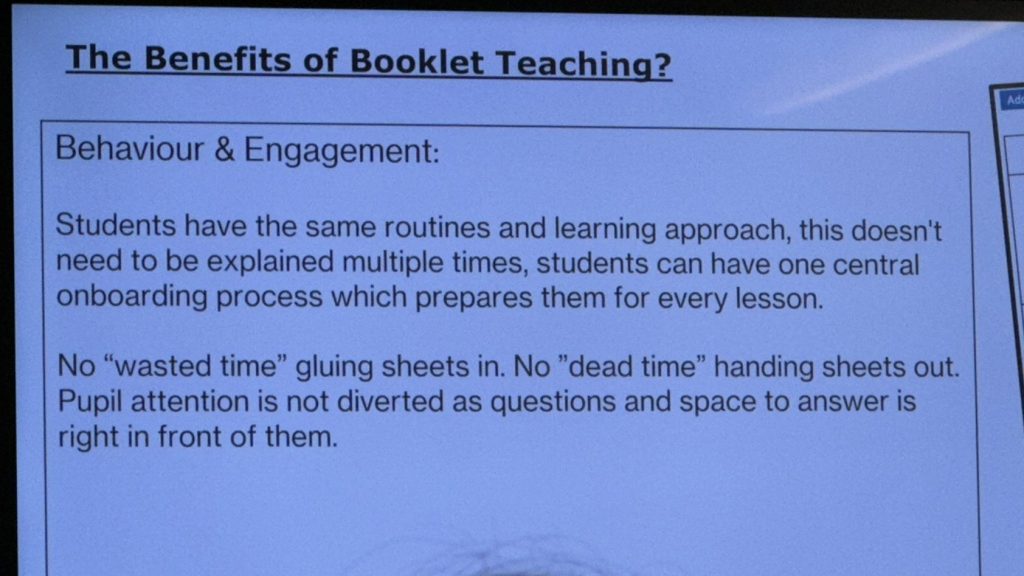
There were clear benefits for a department. Colleagues could contribute their best approaches to a shared resource, establish consistent routines and refine the booklets year on year. Time saved on resource preparation could then go into questioning, explanations and formative assessment. Adam also acknowledged the drawbacks: the initial setup takes time, printing costs money, and producing the booklets can become a substantial job without a reprographics department.
I realised that my own online tutoring already incorporates some of these principles. Each pupil has two main BitPaper workspaces, giving us a consistent place and record of what we’ve covered and what might have been re-visited. Most of my tutees do their daily corbettmaths 5-a-days on a 100 page BitPaper booklet that I’ve made for them. For their homework, my tutees know exactly what they have to do and when. This organisation supports teaching and reduce the small interruptions which can accumulate during a lesson.
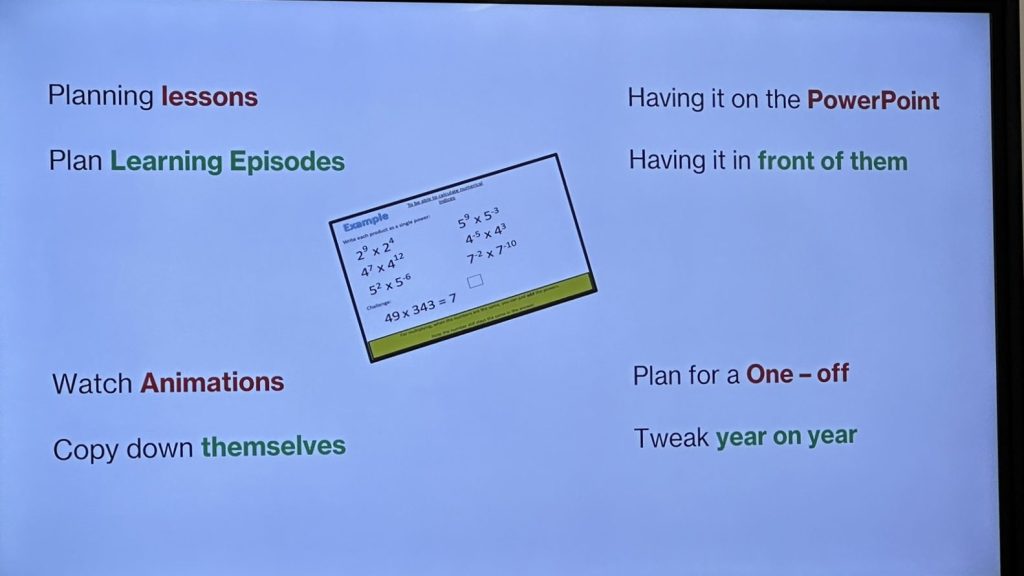
I could almost certainly add even more structure to the live teaching virtual space and to other elements of my tutoring. Plenty of food for thought. The most useful takeaway was an actual example of a booklet itself. You can explore it on this link.
Workshop 3 : What needs to happen for a student to reach Grade 4 in GCSE Maths? by Gareth Shadick
Gareth began by reflecting on how discussions in mathematics education can become polarised. For all its perils, the old twitter algorithm loved a good debate which kept maths conversations alive and present on our feeds. Be that direct instruction versus inquiry-based learning, PowerPoints versus Chalk and talk etc. His suggestion was that these ideas sit on a spectrum, with the most appropriate position depending on the circumstances. Gareth suggested that finding our place on a spectrum may require exploring beyond it. This reminded me of Derek Sivers’s Overcompensate to compensate: what feels balanced may simply be familiar. Trying a different approach can help us judge what works for the pupils in front of us.
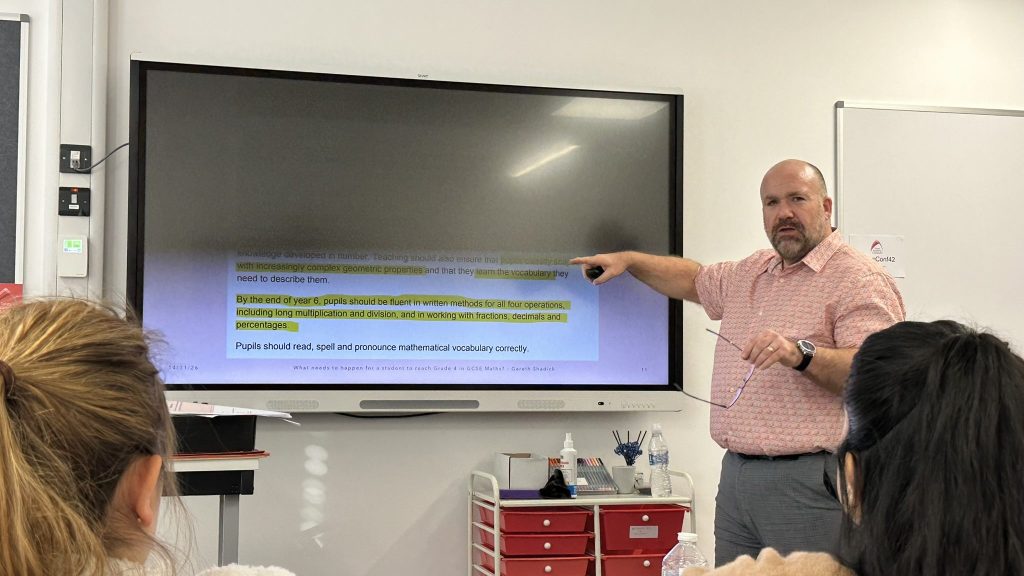
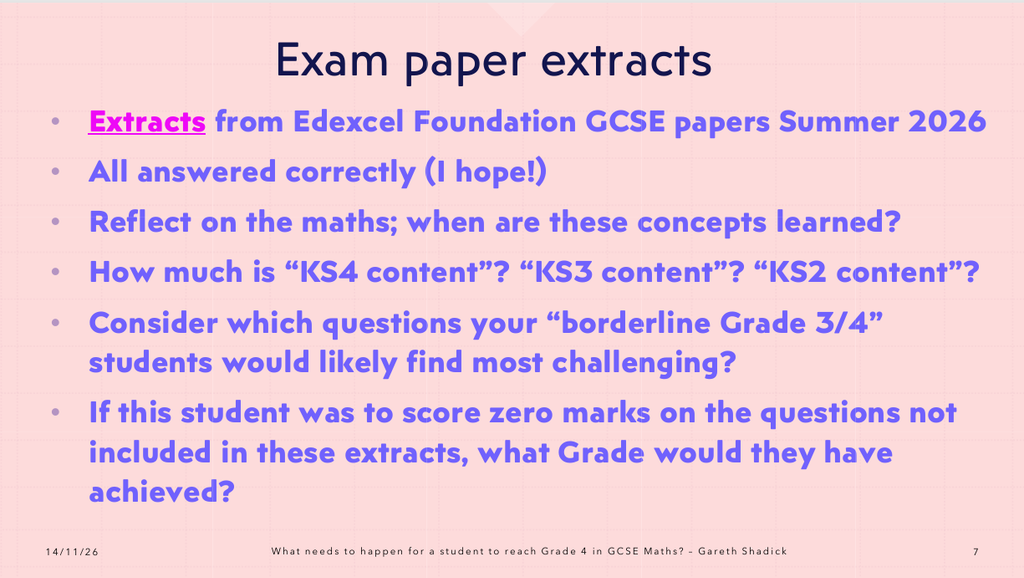
Gareth had given us a carefully selected group of questions from the summer 2026 Edexcel Foundation papers. We discussed the questions with each other considering when pupils first encounter the mathematics needed to answer them. How much belonged to Key Stage 2? How much to Key Stage 3? What, if anything, required specifically Key Stage 4 content? Gareth also gave us a copy of the primary curriculum for reference.
I remember that one question asked pupils to put five decimal numbers in order of size which I correctly identied as KS2 content. I also placed multiplication of two numbers with decimal parts in KS2, but multiplying decimals by whole numbers is the limit of KS2.
We then added up the marks available. The total was 151 marks which is exactly the grade 4 boundary for that year, even with nothing earned from the questions left out. It was clear that most of the selected questions were on mathematics taught before KS4. This challenged the assumption that the route to a grade 4 necessarily involves pressing ahead through more advanced content. For pupils whose earlier understanding remains insecure, could that time be used more productively?
There is an important distinction here between recognising the content of a question and being able to answer it though. Mathematics introduced in primary school can appear in a demanding GCSE problem. Pupils still need to interpret the question, recognise relevant relationships, choose a method and carry it through accurately.
This is where the workshop connected strongly with my tutoring. I often work with pupils who are being taught material several years beyond their current understanding. So I have to first determine their true starting point rather than try to keep them up with their school coverage, going into KS1 maths if necessary (as is often the case). And therin lies the tension in my own tutoring, I want ambitious mathematics for pupils, as I love the subject and want them to see the bigger picture. But I know that addressing the absolute fundamentals is non-negotiable.
On the other hand, with some of my higher-attaining Year 6 tutees, I can go into more depth with the same key topics. I explore different number bases, including carrying out familiar addition and subtraction algorithms in those bases. This gives us a fresh way to examine place value, regrouping and why the algorithms work. I also use Junior Maths Challenge questions, where relatively familiar content can demand considerable ingenuity. Some competitive 11+ questions likewise require more reasoning than many questions on a Foundation GCSE paper. These experiences remind me that the content involved and the depth of thinking required are different things. Mastering the KS2 curriculum alone does not guarantee a GCSE pass, but there is far more mathematical depth available within earlier topics than their curriculum labels might suggest.
Gareth also highlighted that around 28% of 16-year-old GCSE maths candidates in England had not achieved at least a Grade 4 last year. We were asked to reflect on the reasons. Some of them that I can think of being : interrupted education, unmet additional needs, language difficulties, accumulated gaps, circumstances outside education and constraints on staffing and support. Jo also mentioned behaviour which she (and Nathan) have recently written about.
Gareth’s closing suggestions included teaching for depth from the outset, checking prerequisite understanding thoroughly and responding to the gaps identified. He also emphasised developing mathematical behaviours and explicitly teaching problem-solving strategies.
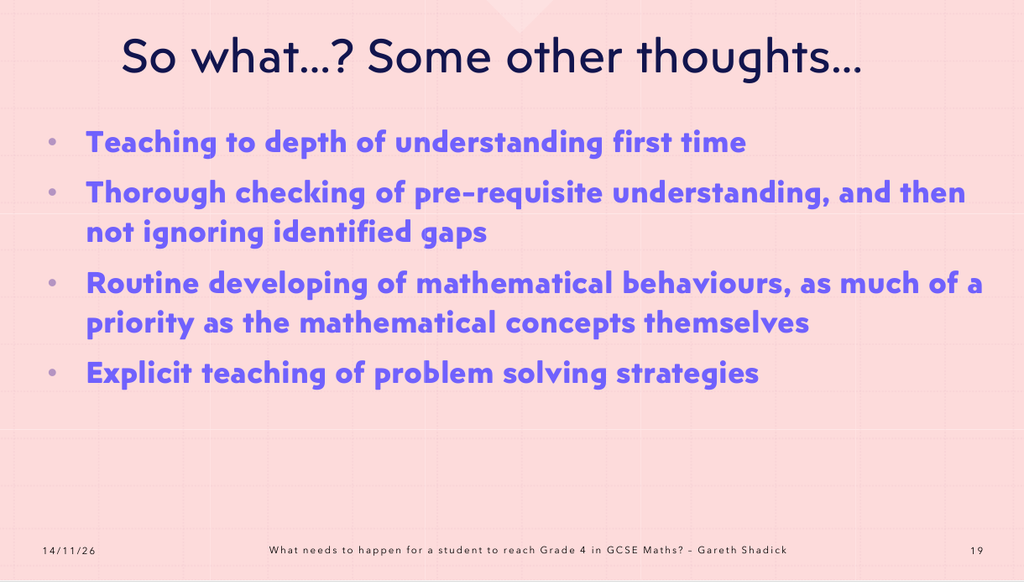
This connected with his opening observation that educational decisions often sit on a spectrum, despite being discussed as opposing positions. Curriculum pacing is one such decision. Pupils need opportunities to move forward, but the timing should make sense. Thoughtful sequencing, careful assessment and teacher CPD can help us make those decisions better, even with wider constraints.
Gareth’s final question stayed with me:
“What if these students only learned the ‘KS3 content’ by the end of Year 11?”
Workshop 4 : Simultaneous Equations in Depth by Jo Morgan
Jo’s workshops are always full of insights, and it is hard to resist photographing every slide even when I know the presentation will be available afterwards (now available here). Jo has recently made a return of her Topics in Depth series, exploring how a teacher’s understanding of a topic can enrich their teaching.
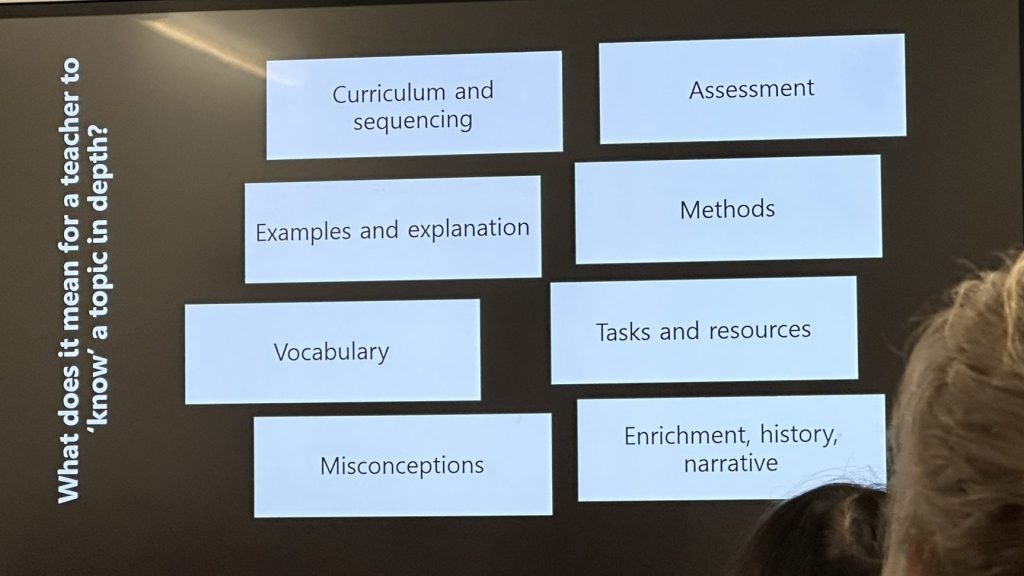
That idea resonates strongly with me. When I first explored place value in different bases, I began to see the structure, beauty and elegance of our number system in a way I never had before. It transformed my teaching of place value. What I learned goes beyond the lessons in which I explicitly teach other bases: it influences my explanations, my choice of examples and the enthusiasm I bring to the topic. A pupil may never explore another base with me and still benefit from the fact that I have.
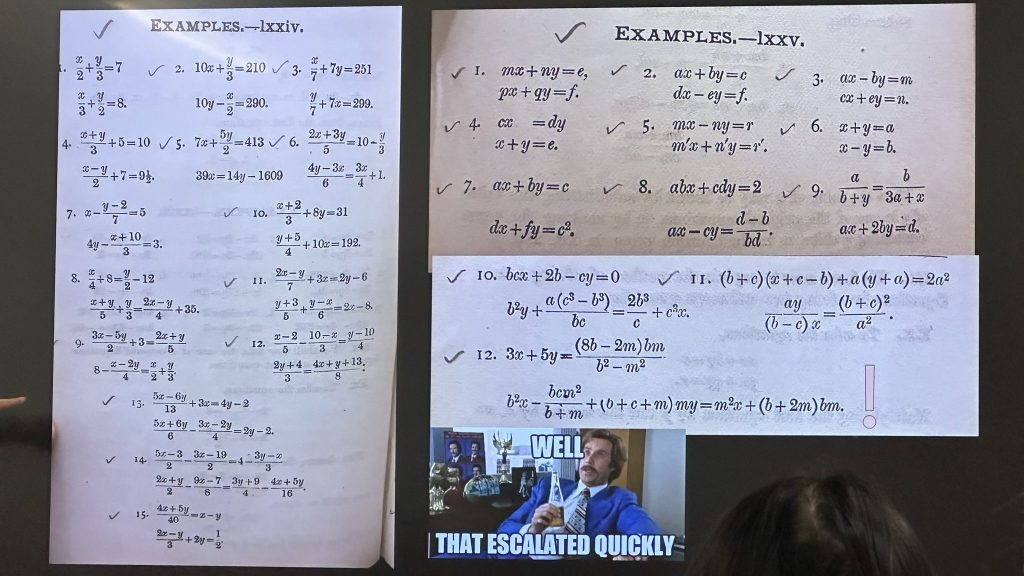
Jo’s focus was on algebraic methods for solving simultaneous linear equations: elimination, substitution and equating. We considered how the way equations are presented can make one method more convenient than another. Examples from Durell’s Algebra, dated 1914, invited us to choose an approach before carrying it out. Method selection deserves attention in its own right.
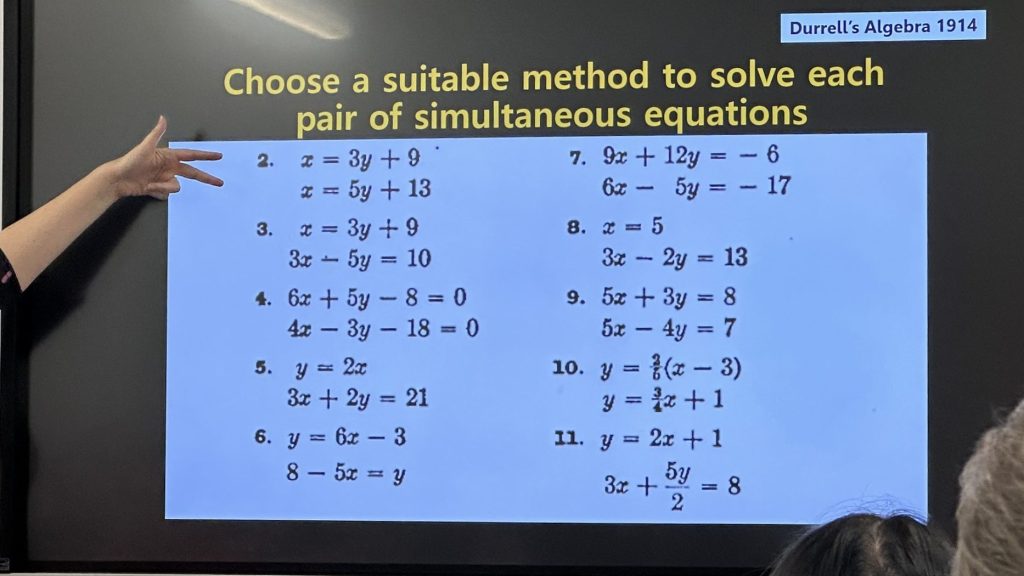
Equating led us back to Euclid’s first common notion: “Things which are equal to the same thing are also equal to one another.” This connects to the transitive property of equality: if two expressions both equal y, they must equal each other. Substitution replaces an expression with another of equal value; elimination combines equalities to remove an unknown. Making these connections explicit could help pupils see why the procedures work and how they relate.
Alongside flexible method selection, we explored procedures designed to reduce the number of decisions pupils make. One approach involved multiplying each equation by the coefficient of the chosen variable in the other equation, producing matching coefficients ready for subtraction. Jo credited this to “a student I once taught”. I loved this, and it shows an openness to learn from pupils. Another, from Mark Horley’s blog, used negative multipliers where needed to produce opposite coefficients, allowing elimination by addition every time.
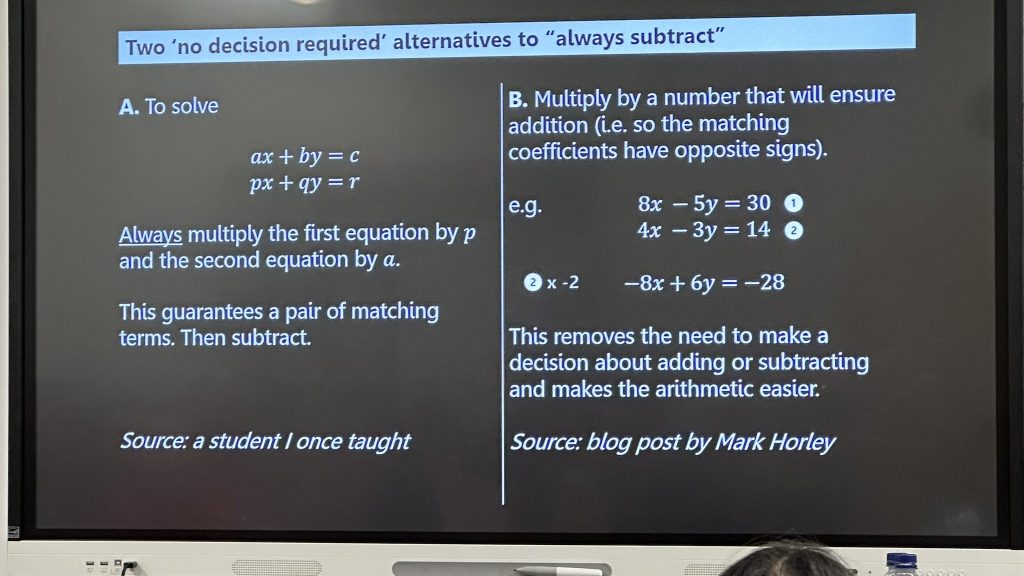
There is an interesting tension here. I want pupils to recognise an efficient route, but I can also see the value of a dependable procedure while they are getting to grips with the algebra. How much choice is helpful at a particular stage? When is a pupil ready to compare approaches?
Jo also paid careful attention to what a solution actually means. One task asked pupils to substitute given pairs of values into different systems and check whether they satisfied both equations. A single linear equation such as 3x+2y=12 has infinitely many solution pairs: the values can vary, but they are linked. A second equation adds another constraint. Where a unique solution exists, we are seeking the one pair that satisfies both equations simultaneously. It is easy for that meaning to disappear beneath the steps of a procedure.
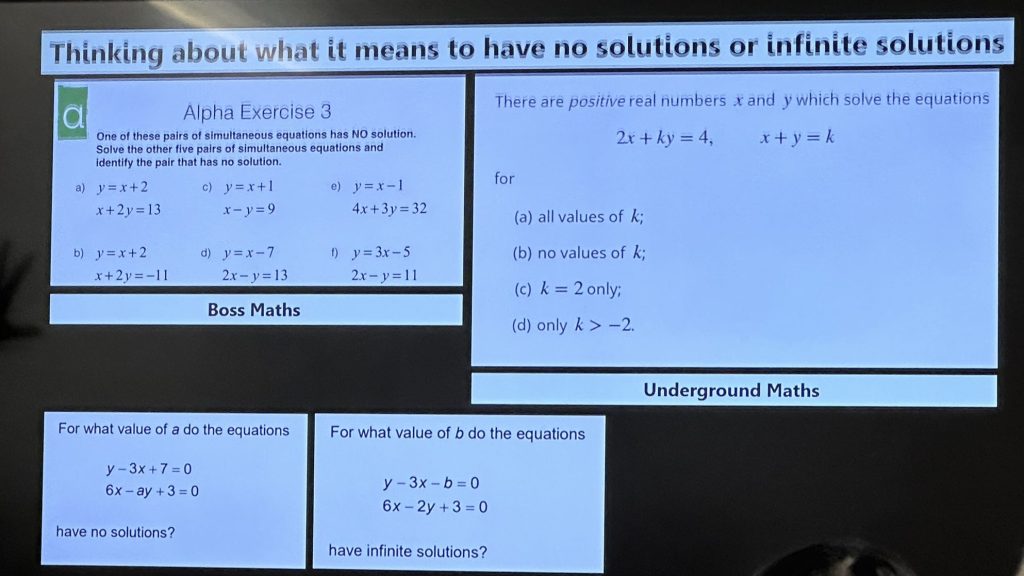
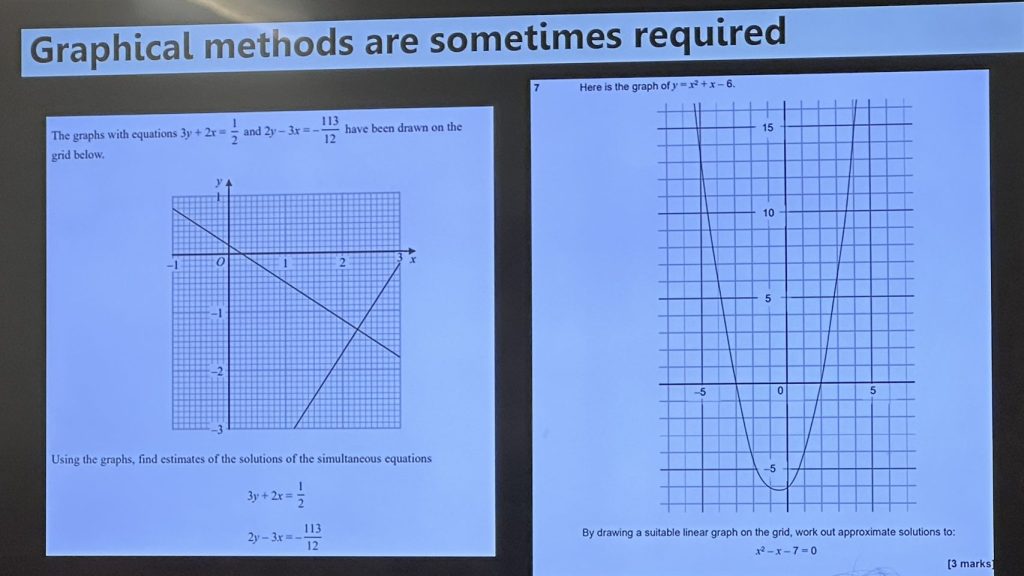
The graphical examples offered another way to make this visible, including systems with one solution, no solutions or infinitely many. A further example connected graphical solving to rearranging a quadratic equation so that its solutions could be found using an existing curve and a suitably chosen straight line.
There are also several stages within a solution that deserve attention separately. Finding x does not finish the problem: substituting it back and solving for y may still require substantial algebra. So that skill could be practiced using backward fading, where pupils initially complete the final steps before taking responsibility for more of the solution. The “tick trick” also lends itself very well to the topic of simultaneous equations.
Jo finished off by suggesting that this topic should be allocated sufficient teaching time to be taught in the depth that it requires.
After the workshop, a teacher shared a puzzle with Jo, and the learning continued in the other direction. That exchange captured something I love about MathsConfs – everyone has something to learn and something to offer. The puzzle’s next destination was on the train back to London, where I got on board too. But more on that later.
Workshop 5 : Authentic and Stylised Contexts: Redefining ‘real world maths‘ by Dr Ed Southall
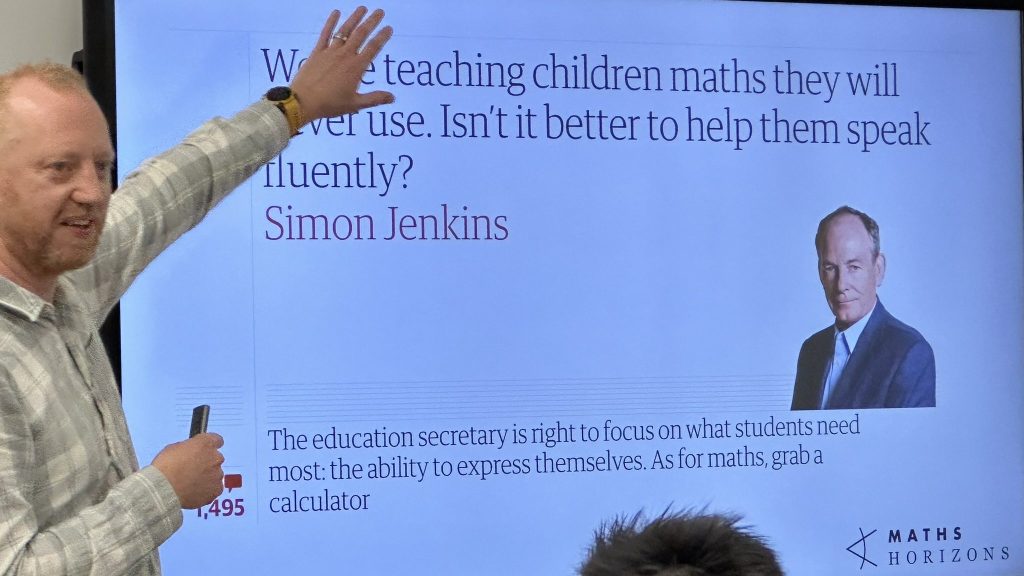
Ed showed us a slide with a Guardian headline by Simon Jenkins questioning the usefulness of school mathematics, drawing our attention to the huge number of comments beneath it. The question of ‘what mathematics is for?’ clearly touches a nerve. Indeed, while I was writing this post, the DfE announced some soundbites at what might be coming in the curriculum reforms. Promising stronger connections between mathematics and everyday financial decisions, from savings to mortgages. So Ed’s workshop now feels particularly timely. When we talk about making maths “real world”, what exactly do we mean? His distinction between authentic and stylised contexts gave us a useful way to examine that question.
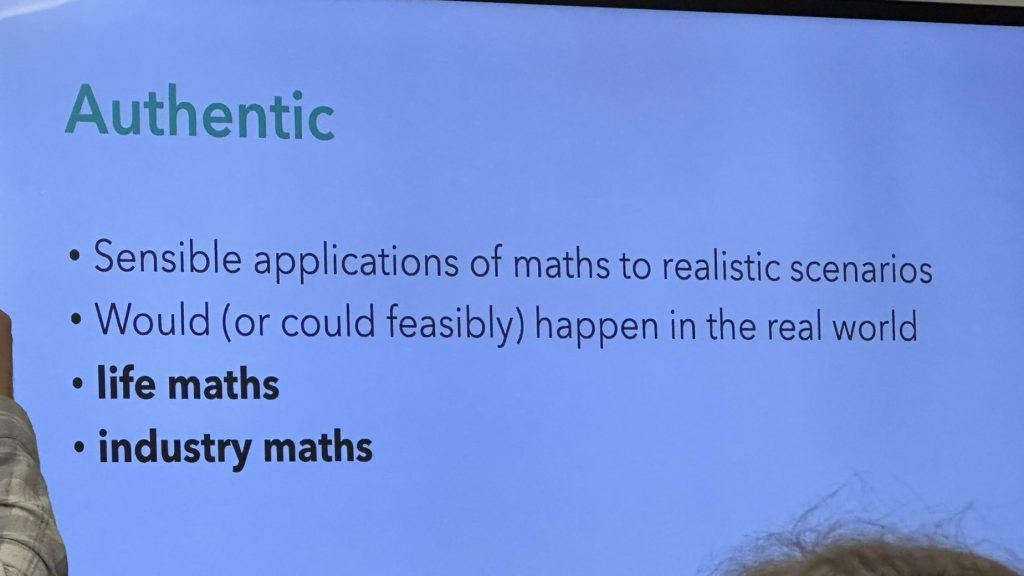
Authentic problems involve plausible applications of mathematics in everyday life or industry. One example asked pupils to calculate an electricity charge from two meter readings and a price per kilowatt-hour. A smart meter or app may already provide that answer, so the value of the question lies partly in understanding how the charge is calculated. Stylised problems, meanwhile, use imagined situations to give mathematical relationships a setting. Both can be useful, but describing everything with a story attached as “real-world maths” overlooks what each is trying to achieve.
Applications were an obvious starting point for me as a tutor. Coming from mechanical engineering, software engineering and music, I could find connections almost everywhere: quadratics and the trajectory of a ball, geometrical constructions and sheet-metal work, fractions and musical notation. Before discovering maths conferences and the wider CPD community, these connections were central to how I tried to make mathematics meaningful.
Yet usefulness and meaning are not the same thing. I remember a primary pupil declaring, “Paying tax is mean and we shouldn’t pay it,” while working through an income-tax question after explaining what tax is and why it exists. At that stage in their life that tutee had no real connection to paying, calculating or worrying about tax. Don’t we all wish we could go back to that blissful time in life!
Perhaps some adults who say they were never taught useful mathematics encountered applications that meant little to them at the time. Equally, completing a question at school does not guarantee recognising the mathematics when we need it years later. These are questions about understanding and transfer, as well as curriculum content. And practical usefulness is only part of the subject’s value. We do not study English solely to read instruction manuals, nor mathematics solely to calculate tax.
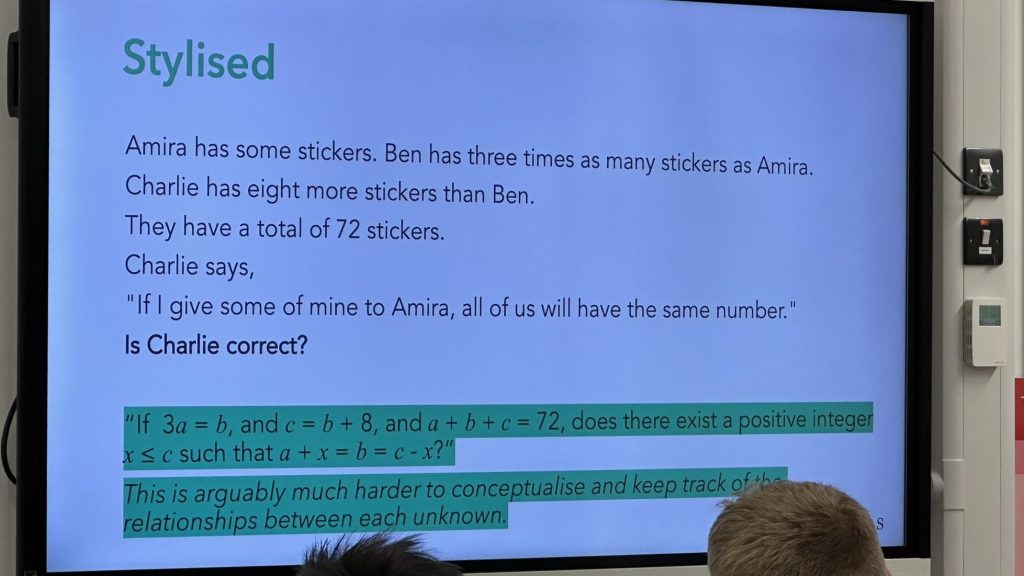
Ed illustrated the value of stylised contexts with a problem about Amira, Ben and Charlie collecting stickers shown below. The same relationship was expressed as a word problem and compared in purely abstract algebraic language. The comparison made his point particularly well, the characters and stickers give us something to picture and help us keep track of the quantities. We can imagine Charlie giving stickers away, Amira receiving them and Ben’s collection remaining unchanged. Written entirely in symbols, those relationships may be harder for a pupil to follow. The context has a mathematical purpose even if the situation is contrived.
This connects with my own use of simple stories to help tutees distinguish multiplication from quotative division. But, as Ed pointed out, a context can both remove a layer of abstraction and add a layer of interpretation. Familiar objects may help one pupil, while the language and relationships create additional demands for another. The characters of Amira, Ben and Charlie are extra details that the working memory now has to handle.
Ed’s workshop left me thinking about the difference between giving mathematics a setting and giving it meaning. An electricity bill is authentic, but it does not automatically explain the operations needed to calculate it. Pupils can meet plenty of realistic questions while still experiencing mathematics as a collection of mysterious rules.
For me, this connects to the importance and interconnectivity of the four modalities CPAL – the use of manipulatives and visual representations, language and abstract symbolism. Along with using different models (area model, bar model etc.). I suspect that some people’s disconnection from mathematics begins when symbols and procedures arrive without enough opportunity to understand what they represent. Arranging equal groups, comparing lengths or making exchanges can give pupils relationships to explore and explain. With careful teaching, these experiences can be connected explicitly to manipulatives, drawings, stories, metaphors, models etc., and revisited whenever needed.
The train home and the legacy of Complete Mathematics
The conference wrapped up with the raffle prize winners being announced. I felt that amazing glow of new knowledge and ideas to try out and reflect on my return to London. It was time to take the return train, relax and let it all sink in. Little did I know that there was more to come. On the train I bumped into Jo, Nathalie, Pete, Dave and Megan. We got two tables together and maths-ed away! Jo was excited to share a task with us which I remember as follows:
Choose three consecutive terms that form an arithmetic sequence and use them, in order, to fill the boxes in the first equation. I.e the coefficient of x, y and the constant term all follow an arithmetic sequence. Repeat with another arithmetic sequence for the second equation.
□x + □y = □
□x + □y = □
For example, choosing 1, 2, 3 and 5, 8, 11 gives:
1x + 2y = 3
5x + 8y = 11
Solve your equations, then try some different sequences.
All of us ended getting the same solution pairs, even when we chose different equations. How could this be? This is the moment of marvel that we all love as maths teachers, some sort of connection in mathematics that needs further probing. The next thing for us was to generalise the equations and come up with an algebraic proof.
After the proof we were left with more things to think about : Why exactly does this work? What would happen with quadratic sequences? etc. I even plotted the two generalised lines on Desmos. Jo had learned about this task by another teacher at the end of her workshop. When Jo later shared the task online, it was identified as a RISP task as Jo mentioned in her blog post of #MathsConf42. Some teachers already knew it well. For those of us discovering it on the train, it was new and absorbing. Even after a whole day of workshops, we still wanted to know why it worked.
This brings me back to Will’s opening story that enthusiasm for maths is infectious, passed from one to another and inspiring further exploration. The teacher who shared the puzzle with Jo could hardly have known how we would spend our journey home. I wonder where it will turn up next, and whose curiosity it will catch.
In his 2015 post about MathsConf, Mark McCourt described wanting teachers to learn from one another and form supportive friendships “so that no teacher must stand alone”. Nearly ten years and 27 conferences later, I can say that he achieved that for me. As a private tutor, I found colleagues and friends with whom I could question my teaching and explore new ideas. That evening on the train, we were still doing exactly what he had brought us together to do.
Barnsley marked the end of the chapter Mark began in 2014, and I am sad to see it close. The wider contribution Complete Mathematics has made to my life deserves a separate post. For now, I am grateful to everyone who made this final gathering possible: the organisers, hosts, volunteers, workshop leaders, exhibitors and AQA. Particular thanks to Jo Ball for her energy through such difficult circumstances, and to her daughter Natasha for the fresh designs she brought to the conference’s social media.
There is already another gathering to look forward to: The Maths Connection, a teacher-led maths conference in Stratford-upon-Avon on Saturday 20 March 2027. Follow Jo Morgan (Resourceaholic) and Mel (JustMaths) on social media for updates.