Why Writing Things Down Makes You Better at Mathematics (And Why Teachers Insist on Showing Your Working)
Anyone who has spent time in a maths classroom will have heard the instruction:
“Show your working.”
For many students, this feels unnecessary. If they believe they can do the calculation in their head, writing it down seems like extra effort.
But writing is one of the most powerful thinking tools humans have ever developed.
In fact, when a student writes their mathematics down, they are tapping into a technology that has been helping humans think clearly for thousands of years.
Writing: One of Humanity’s Oldest Thinking Technologies
Humans have spoken language for tens of thousands of years. But writing appeared much later, around five thousand years ago, in early civilisations such as Mesopotamia and ancient Egypt.
The earliest written records — many of which can be seen today in collections such as those held by the British Museum — were not stories or literature. They were practical records: trade accounts, grain inventories, taxes and legal agreements.
Over time, however, writing began to do something much more powerful.
It allowed humans not just to record information, but to actually think more clearly.
Once ideas could be placed outside the mind — on clay tablets, papyrus, paper, or today on screens — people could inspect them, rearrange them, and build on them. This shift made it possible for mathematics, science and philosophy to develop in ways that would have been extremely difficult if everything had to remain inside the human head.
Mathematics in particular is deeply tied to written symbols. From ancient Babylonian tablets to modern algebra, mathematical thinking has almost always happened on paper.
Even simple symbols such as the plus sign have fascinating histories of their own, something I explored in a previous post on the history of the plus sign.
Why Writing Is a Superpower in Mathematics
Many students believe that doing maths in their head is a sign of intelligence. If they can mentally juggle the numbers, they assume they are working efficiently. In part, this probably comes from early mathematics experience when speed of number bonds and multiplication were rewarded.
But the human brain has a major limitation: working memory.
Working memory is the small mental “workspace” where we temporarily hold information while solving problems. And it is surprisingly limited. Most people can only keep a handful of pieces of information active at once.
This is where writing becomes incredibly powerful.
When a student writes their working down, they effectively create an external working memory.
Imagine you were just introduced to ten different people and had to remember every face and name five minutes later. That’s tough. The same happens with maths problems. Instead of trying to hold every step inside the mind, the brain can offload parts of the problem onto the page.
That way numbers stop disappearing in the mind’s memory.
Intermediate steps remain visible.
Relationships between quantities become easier to see.
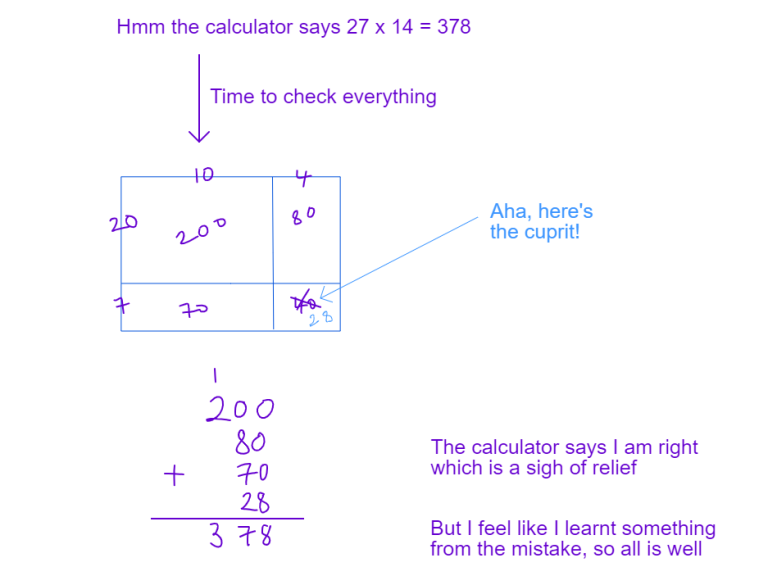
Mistakes become easier to detect as all steps of the problem are visible.
In other words, writing allows the brain to focus on higher order thinking, rather than simply trying to remember everything.
The Hand–Brain Superpower Built by Evolution
There is another reason writing is such a powerful learning tool, and it has deep evolutionary roots.
The human hand and the human brain evolved together.
Our ability to control the fingers with extraordinary precision allowed early humans to make tools, carve objects, draw symbols and eventually invent writing itself. These activities required close coordination between the eyes, the hands and the brain.
Over hundreds of thousands of years this hand–brain partnership helped shape the neural systems involved in planning, sequencing and symbolic thinking.
When a student writes mathematics by hand, they are engaging this same system.
Handwriting is not simply a way of recording thoughts. It activates fine motor control, visual attention and reasoning at the same time. Multiple areas of the brain work together to guide each symbol onto the page.
In fact, research using brain imaging has shown that handwriting activates far wider neural networks involved in learning and memory than typing on a keyboard. Studies examining the brain activity of students while writing have found that the movements involved in forming letters and symbols appear to strengthen the brain systems that support understanding and recall. You can read one such study discussing these effects on the National Library of Medicine here:
https://pmc.ncbi.nlm.nih.gov/articles/PMC11943480/
This may help explain why writing things down often leads to clearer thinking. The brain is not working in isolation — the hands are part of the thinking process.
The evolutionary connection between movement, learning and human intelligence is something I explored further in another article on this blog: The Learning Animal: How Evolution Made Humans the Only Species That Must Be Taught.
The Paradox: Writing Feels Like More Effort (But Makes Thinking Easier)
Many students resist writing because it feels like extra work.
Doing everything mentally feels quicker and easier at first. Why bother writing when you can do it all in your head?
There is another reason some students resist writing their working down.
Over the years many come to believe that the goal of mathematics is simply to produce the final answer. After all, most school questions appear to demand exactly that: one correct number at the end.
But this creates a deep misunderstanding.
The final answer is often the least interesting part of the problem.
A calculator can produce answers instantly. Mathematics is really about the reasoning that leads there — the relationships between quantities and the logical steps that connect them.
The working is not just a way of presenting mathematics.
The working is the mathematics.
I will explore this idea further in another article: The Final Answer Is the Least Interesting Part of the Problem.
And this is precisely why writing things down matters so much.
When students try to keep everything inside their head, the brain must do two jobs at the same time:
- remember all the numbers and intermediate steps
- figure out what to do with them
This is like trying to solve a puzzle while also juggling several balls in the air.
Writing removes the juggling.
Once the steps are on paper, the brain can relax its memory load and concentrate on reasoning. The structure of the problem becomes visible. Often the next step becomes obvious simply because the information is laid out clearly.
Students frequently experience this moment: they write something down almost reluctantly, and suddenly the solution begins to unfold.
The very act of writing slows thinking just enough for clarity to emerge.
What feels like extra effort is actually a powerful cognitive shortcut.
In fact, the very act of writing often generates new ideas.
Action Creates Thinking
There is another powerful truth about writing that goes beyond mathematics.
Author Mark Manson captures it beautifully in his book The Subtle Art of Not Giving a F*ck. He recalls advice from a maths teacher:
“If you don’t know how to do a problem, start writing something down, your brain will begin to figure it out as you go.”
And this is exactly what happens in mathematics.
When students stare at a blank page trying to think their way to the perfect method, nothing moves forward. They remain stuck at zero.
But the moment they start writing — even if the first step is imperfect — something changes.
New thoughts begin to appear. Connections form. The brain starts exploring possibilities.
Some ideas will be correct. Others will be wrong. But those wrong steps are incredibly valuable because they provide information. A type of negative feedback loop.
Anything that is written out on paper can be seen, analysed, and corrected. A thought that never leaves the head cannot.
In mathematics, progress almost always begins with action.
Writing Helps Students Sharpen Method Selection Skills
This is closely related to another idea I discussed in my article on teaching method selection by articulating thinking.
Many students believe there is always one obvious method waiting to be spotted instantly. In reality, mathematical problem solving is often exploratory.
Students try something. They see what happens. They adjust.
Writing allows this exploration to take place.
Each line of working becomes a small experiment. Some lead forward, others reveal dead ends. But every step provides information that helps the student move closer to the correct method.
Without writing, that experimentation cannot happen effectively.
The page becomes a laboratory for mathematical thinking.
Why This Matters Even More for Students Who Struggle With Maths
For students who find mathematics difficult, writing becomes even more important.
Many learners who struggle with maths — including those with dyscalculia — experience overload when trying to process numbers mentally. Too many quantities and relationships compete for attention at once.
When everything stays in the head, confusion builds quickly.
Writing transforms the situation.
Instead of wrestling with invisible numbers, the student can see the problem take shape in front of them. Patterns emerge. The structure of the calculation becomes clearer. Steps can be checked and adjusted without starting again from scratch.
In this sense, writing turns mathematics from something abstract and overwhelming into something visible and manageable.
This connects closely with another idea I have written about previously: humans are fundamentally a learning species. Unlike most animals, we must be taught complex skills such as mathematics.
Writing is one of the tools that makes that teaching possible.
Mathematics Has Always Been Written
Long before calculators existed, mathematics was performed almost entirely on paper.
In an earlier article, I explored how arithmetic was carried out before calculators became common. The techniques relied heavily on written algorithms, place-value notation and step-by-step procedures.
The written method was not just a way of recording the answer.
It was the thinking process itself.
From Babylonian clay tablets to Renaissance mathematicians to modern classrooms, mathematics has always been a written discipline.
When students write down their working today, they are participating in a tradition that stretches back thousands of years.
The Next Thinking Tool: Writing with AI
For thousands of years, writing has acted as a kind of external thinking system for the human brain.
When we write something down, we move ideas out of our heads and onto a page where they can be inspected, rearranged and refined. In many ways, writing functions like an extension of our working memory.
Today we may be seeing a new layer added to this process.
Artificial intelligence tools are beginning to act as an additional cognitive partner. Just as writing allows us to store thoughts outside the brain, AI systems can help us explore ideas, test reasoning and refine explanations.
In fact, this very article was developed in that way. Over the past few months I have been using tools such as ChatGPT as part of my writing process — engaging in extended back-and-forth conversations to test ideas, challenge assumptions and clarify arguments before shaping them into a finished blog post.
In that sense, AI becomes something like an extended thinking space, helping refine ideas that first begin with writing.
Seen from a wider perspective, this is simply the newest chapter in a very old story. Humans have always used external tools to extend the limits of their thinking — from clay tablets and papyrus scrolls to notebooks, blackboards and now intelligent digital systems.
For writing long-form blog posts like this, I am currently all-in with AI. It has become a powerful partner in the thinking and drafting process.
In mathematics learning, however, the role of AI must be used far more carefully. If students simply ask AI for answers, the very thinking they need to go through disappears. The struggle, the false starts, the cognitive friction — all of the things that actually produce learning — are removed.
As I discussed in a previous article, The Price of Revelation: Why Beauty and Transcendence in Mathematics Requires Pain, difficulty and effort are not obstacles to learning. They are part of the process itself.
For this reason I do not currently encourage my students to use AI to solve mathematics problems. At the moment I mainly use AI to generate practice drills and occasionally as a reflective tool when thinking about pedagogy. My own use of AI in education is still evolving.
But one thing seems clear.
Even as new tools emerge, the core habit remains the same.
Thinking begins when ideas are written down.
If In Doubt, Write it Out
Whenever a student gets stuck during a tutoring session, my advice is often very simple:
If in doubt, write it out.
That single habit has helped generations of mathematicians, scientists and engineers think more clearly.
In an age filled with digital devices and calculators, the humble act of hand writing still remains one of the most powerful learning tools we have.
So the next time a maths problem feels confusing, resist the temptation to keep everything in your head.
Pick up a pen.
And start writing.